
Plantar fasciitis is an epidemic in our society that plagues not only runners, but even sedentary individuals. The most likely explanation for the condition is overuse to the musculature that inserts near the plantar fascia – the abductor hallucis, abductor digiti minimi, and flexor hallucis brevis.

In fact, recent studies show that after performing a plantar fasciectomy (surgical release of the plantar fascia) the tissue sent to the pathologist revealed no inflammatory changes. This leads many practitioners to believe the condition is more muscular which explains the pain upon rising in the morning or after periods of rest. The muscular tissues that are inflamed are attempting to heal themselves and need to be stretched or warmed up to reduce the pain. Then, after periods of activity, the muscles again become sore leading to pain later in the day. The result – chronic pain to the heel and or arch area.
Applying ice to any inflamed has been proven to reduce the inflammation and thereby reducing pain. The most common way of icing the foot is by a traditional back of ice, or even cold vegetables such as peas or corn. While this works very well, repetitive icing is time consuming to prepare a perfect sized ice bag and can be very messy when the ice melts and leakage occurs.
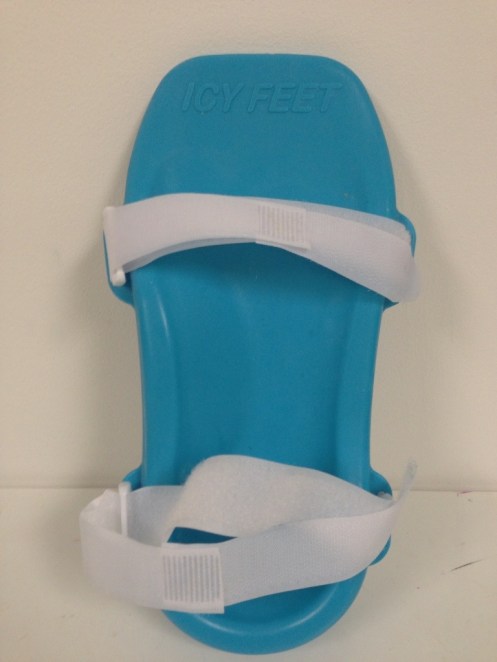
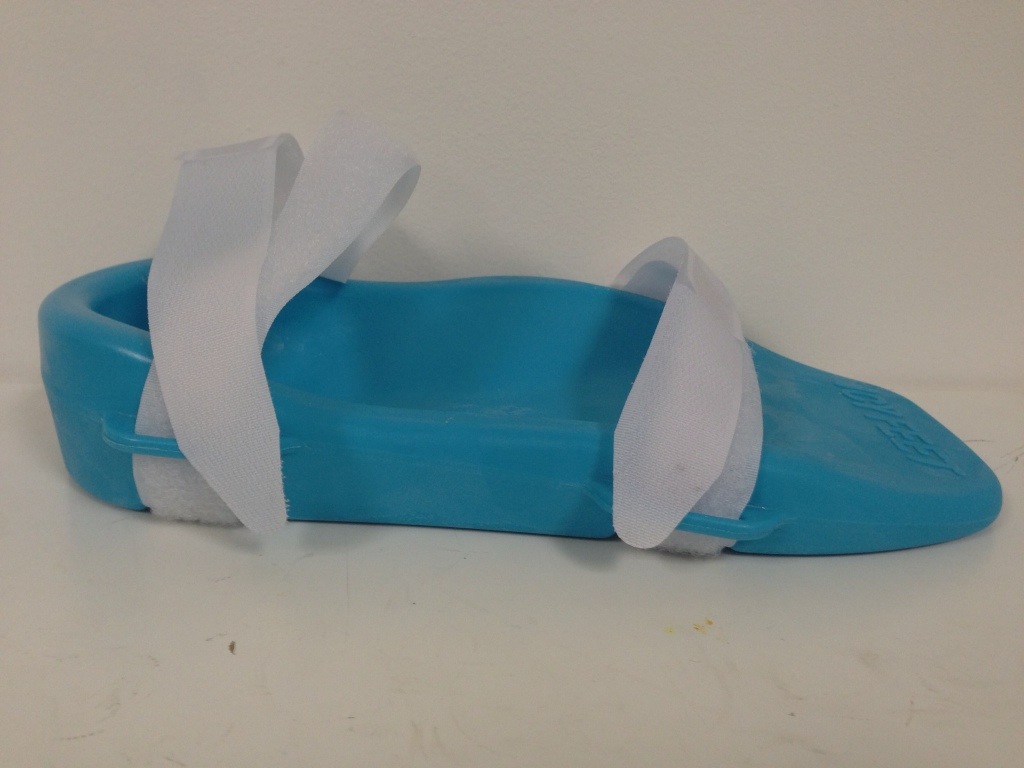
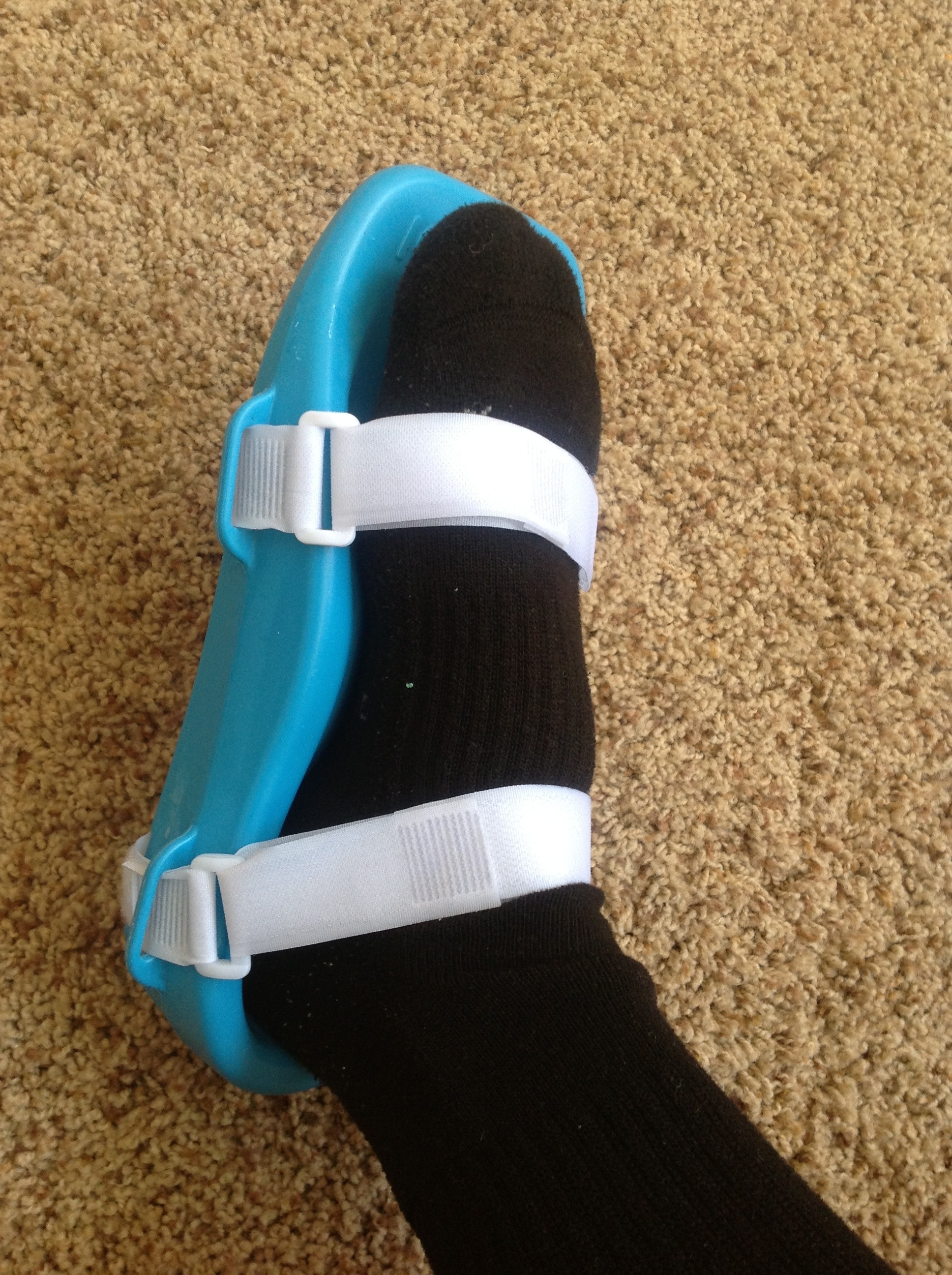
Icy Feet is a simple device that can be quickly applied and provides a cooling effect to the entire plantar aspect of the foot. It is simply a frozen plastic container similar to a freezer pack found in picnic cooler. It is contoured to fit most arches providing contact to heel and arch and midfoot. I was first introduced to this device at The Running Event where it’s designers were displaying the product. I was a bit skeptical being that ice is free and readily available to everyone. At the time I had been suffering from a mild strain of my abductor hallucis muscle from “pushing it” during a 5k race and had been icing occasionally. I was given one to try and can honestly say it is worth the cost. It is nice to quickly grab it and apply in seconds without worrying about preparing an ice bag and getting anything wet. The creators do not recommend standing on it or using without socks but I found both to be fine. It does produce some condensation which made it slippery but it was nice to be able to ice my foot while preparing breakfast and packing my lunch!
The true question I have is does Icy Feet cool tissue to the same degree as ice. When ice melts it pulls the heat from the tissue creating a cooling effect by the transfer of heat. Most studies on on the effects of “icing” and it’s physiologic changes have been done on true ice or frozen water. The product is currently being studied at a university which hopefully will answer these questions.
In the meantime, I would definitely recommend this for anyone suffering from heel pain or arch pain as it is very convenient and easy to use. It also felt great to apply them to both of my feet after a long run!!


Shoe Name: Vibram FiveFingers Lontra
Model: LONTRA
Weight: 6.75 oz
Price: $150.00 MSRP
Drop: zero mm
Website: http://www.vibramfivefingers.com/products/Five-Fingers-Lontra-Mens.htm
Forefoot: Classic wide anatomical forefoot that FiveFingers offer. Tends to have a slightly looser fit as they are constructed with more material consisting of a multi-layer laminate upper with fully taped seams and a micro-pile fleece liner. More material meant a slightly bigger shoe to prevent a tighter fit as well as room for socks given it is a cold weather shoe. Previously when I attempted to wear socks with my Treksports in the snow the fit was too tight constricting my toes leading to even colder toes. This roomier shoe fixed that issue.
Cushion: May feel as if it has more cushion then a typical FiveFinger shoe given its 4mm midsole plating which is nice for rocks on trails. The sole is made with a Vibram TC-1 Dura outsole including slight cleating for excellent grip.
Flexibility: Despite the heavier construction for a winter shoe, it still maintains the classic full flexibility that FiveFingers offer for a minimalist shoe.
Overall: Finally a winter FiveFingers shoe that I can run in when there is slush and snow on the ground. Our first snowfall came this year and it was a pleasure testing these in the snow!!! Perfect!! I did wear socks, which is atypical for me, and it was actually nice because my foot stayed warmer and the roomier fit allowed the socks to help make for a perfect fit. The sole provided more then adequate grip in the snow. The neoprene sock liner is comfortable and kept the snow out. I will say this is a heavier and more bulky shoe then I am used to from Vibram but it is indeed a shoe reserved for extreme weather conditions as well as trails. I even used it to do some sledding with my kids and my feet stayed dry!!
I think they did a great job at making a “Winter” FiveFinger!!


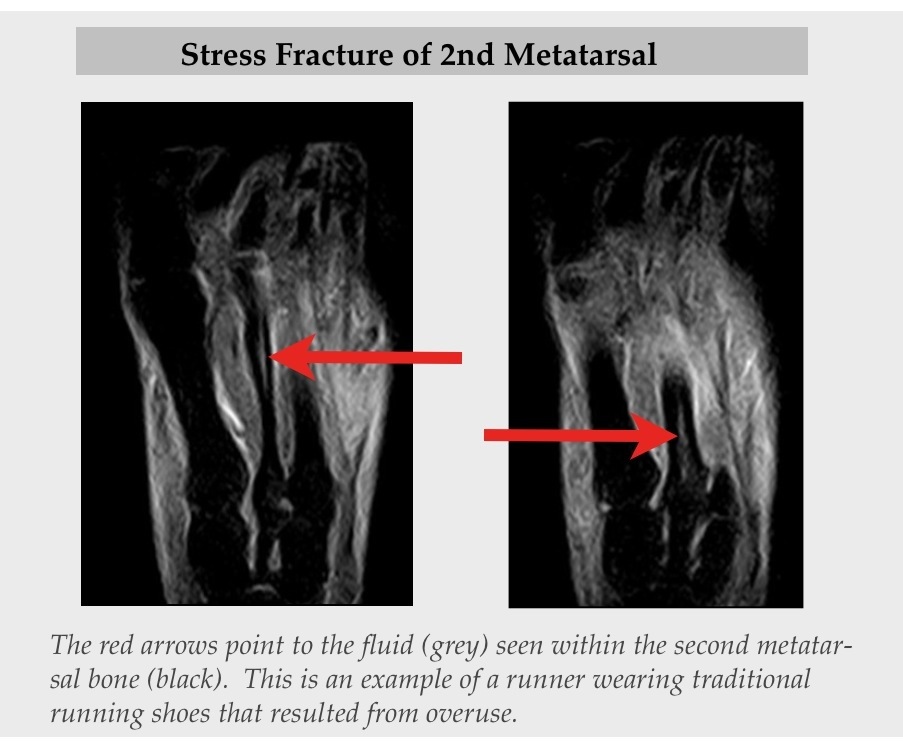
Think you may have a stress fracture in your foot or leg from running? Here are some simple tips on what to look for to help differentiate a fracture from a soft tissue problem such as a tendonitis.
To put to rest all of the rumors that minimalist shoes cause stress fractures, here is a simple statement: Stress fractures result from overuse and osteoporosis. Not shoes
Why then are we seeing the reports of people getting stress fractures from minimalist shoes and running barefoot? Because they transitioned way too quickly and created an overuse phenomena that their foot was not ready for. It is no different then going to the gym and doing 300 bicep curls. You will overtax muscles that haven’t adapted and put excessive stress on the bones of the foot from faulty biomechanics as a result of fatiguing muscles.
So how do we tell the difference between a boney problem and a soft tissue problem?
Tendonitis tends to hurt more upon arising in the AM and then subside as we move around only to become painful again later on in the day. It may even feel great during a run, but towards the end, and especially after become more painful. When suffering from a chronic tendonitis you may actually have good days and bad days associated with activity and the healing process. Surprising as it may sound, complete rest is not always best for a tendonitis. Tendon repair actually occurs when positive stress is applied in a controlled manner such as with physical therapy.
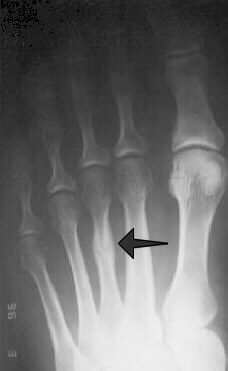
Stress fractures will often present with constant pain that lingers most of the day and doesn’t improve with running or activity. It actually will get worse. Stress fracture pain is also very point tender, meaning the pain is in an isolated area and very sharp when pressing in that area. Stress fractures are most common to the fourth metatarsal in the foot, the tibia of the lower leg, and vary rarely in the heel bone (calcaneal stress fracture). Plantar fasciitis is commonly misdiagnosed as a stress fracture too often after a bone scan is ordered for further examination. MRI is the study of choice to diagnose a stress fracture when it is being considered in any runner. Many times an xray will not show signs of a stress fracture for 2 weeks when and MRI can show immediate changes. This is crucial because altering training patterns for two weeks when waiting for xray changes can be detrimental for any runner.
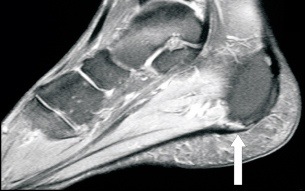
Plantar Fascitis commonly misdiagnosed as a calcaneal or heel stress fracture.

Below is a excerpt from Pete Larson’s blog, The Run Blogger, where he addresses the future of minimalist shoes. For those who aren’t familiar with Pete, check out his blog at http://www.runblogger.com, where he personally reviews running shoes and has hundreds of posts discussing running, running form, and running shoes. Here he is responding to Simon Bartolds negative answers to questions from an interview in SGB Weekly regarding where he sees minimalist shoes in the sport of running. Simon is an international research consultant for ASICS, who has yet to release a product that can truly be categorized as a minimalist shoe. ASICS, is the only remaining mainstream shoe manufacturer to not introduce a minimalist shoe.
The reality is that minimalism and zero drop are far from dead – one need only look at the number of zero drop offerings coming out in early 2013 from top 7 brands like Mizuno (Be, Levitas, Cursoris), Brooks (PureDrift), and Saucony (Virrata) to see that zero drop is alive and well (not to mention that New Balance has a large suite of minimal offerings, Nike has the Free line, and adidas just released their own “adipure” natural running line a few months ago – of the big 7, seems that Asics is the only one not joining the minimal party, though they are testing the waters with the Gel-Lyte). Even small and niche companies are getting into the market with minimal spectrum offerings – Altra has developed a strong following and has a suite of new zero drop shoes coming in the next year, and Merrell continues to add zero drop models to their stable of offerings (would they be doing that if their sales had totally tanked?).
Minimalism is not dying, it’s evolving. We are learning through self experimentation – for example, I still like to run in a barefoot-style shoe from time to time, but I prefer a bit of cushion for most of my runs, many of which are in zero drop shoes. We are seeing the pendulum swing back a bit away from extreme minimalism, but more low and zero drop cushioned offerings are on the way. Minimalism may be dead for Asics, but then they never set foot in that market to begin with – it’s hard to evolve a product that you never made a go at.
Pete’s entire article can be seen here : http://www.runblogger.com/2012/12/the-future-of-minimalist-running-shoes.html?m=1
Have you ever started out with a group of runners and they “take off” right from the start and you find yourself breathing heavy and struggling to keep up? Eventually the pace slows down but at this point it’s too late and your body has already burned excessive glycogen, utilized the wrong muscles fibers, and basically wore you down for the rest of your run. For a distance runner this can mean accelerating to goal pace or faster we placing the hard part of the workout at a pace you may not be able to maintain.
According to Sean Wade, 1996 Olympic Marathoner for New Zealand, every single run or workout should be a negative split. The first mile of a distance run should be super easy and as we naturally warm up we should get quicker. Even for harder intervals or tempo runs we should be easing our ways into them.
The benefits of warming up are:
-Increased respiration
-increased circulation
-improved flexibility
-reduced chance of injury
Going out too fast overtaxes our bodies causing us to inevitably finish too slow.
Portions Borrowed from Running Times.

Running Times published a section in this month’s magazine discussing common mistakes that runners make. I’d like to focus this weeks blogs on a few of these by reviewing them. If they seem to overlap a bit, it’s because the mistakes tend to build on each other through different principals.
Mistake: Training at goal pace.
Walk before you run. Running at goal pace won’t get you there any faster. Incremental steps can make us better runners. A common error many runners make, especially when training for a long distance race such as the marathon, is to run their long runs at “goal pace”. They believe that this will prepare them for race day and they may even be able to run faster given that they are used to this pace. Unfortunately (or fortunately as many believe once they understand this!), that is not how the body responds to stress and improves. Be patient and allow the body to adapt. Running your long runs slower will allow the body to gradually adapt and in some ways recover for a harder run that is approaching. It is common in training for a marathon to have 2 important runs a week – the tempo run and the long run. Everything else (including the long run) is done at an easy aerobic pace.
Running at goal pace will not get us to goal race shape more quickly. If it worked that way, then every runner who went to the track and ran 200m reps in under 30 seconds would be a 4 minute miler. If we train for goals as if we already achieved them we will most likely overtrain and end up with an injury.
“STRETCHING”
Stretching has long been a hot topic among distance runners. I don’t do any static stretching. I have found that the best way for me to stay relatively loose and injury free is to incorporate dynamic and active stretching into my daily routine. Every morning before I run, I do a dynamic flexibility routine that includes leg swings, hurdle exchanges, and other similar exercises to get my legs loosened up after a night’s sleep. After the run, I spend 30 to 45 minutes doing self-massage with a roller and softball and then do more active stretching.
Active stretching activates the muscle opposite the one you are trying to stretch. For example, lie on your back while holding a rope that is looped around your right foot. Use your right quad to bring your right leg straight up with the knee strong but not quite locked. When you get as far as your leg will naturally go in the air, use the rope to pull your leg a few inches farther. You should feel a deep but not trembling stretch in your right hamstring. Try to keep the rest of your body lying flat on the ground.”
Excerpt From: Hall, Ryan. “Running with Joy.” Harvest House Publishers. iBooks.
This material may be protected by copyright.
One of the best books available that every runner should read is Phil Maffetone’s The Big Book of Endurance Training and Racing. Many of the posts I write and tweets that I make are based on Maffetone’s philosophies. He adheres to the principals of running easy (which is relative) at your aerobic pace. Your aerobic pace, according to Maffetone, is measured by heart rate and is found by taking 180-age. If you have been training for two years or more with no injuries you can add 5 beats to the calculated rate. Logging as many miles as you can at this pace taking into account rest and gradual adaptation will build a strong base for racing season. During this base building period no anaerobic training or even tempo workouts should be performed. In fact, Maffetone says that 4-6 weeks of anaerobic training is all that is necessary to see improvements in speed before competing.
Mark Allen (a six time ironman world champion) was trained by Phil Maffetone and has wrote the forward for this must have book. Mark overcame chronic injuries and dramatically improved his running by following Phil’s principals.
This book is equivalent to a drivers license – you shouldn’t drive without one and you shouldn’t run without reading this book.
See link below for Phill Maffetone’s Book.
The Big Book of Endurance Training and Racing

Dr. Philip Maffetone. “The Big Book of Endurance Training and Racing.” Skyhorse Publishing, 2011-02-15.


The majority of literature surrounding energy gels or goos tends to be regarding which brand or flavor to use, and at what point of training to ingest them. The real question is are they needed?
The whole idea of ingesting one of these supplements is to obtain energy through the source of glucose or carbohydrate. Our bodies are able to utilize its own glycogen stores for a given period of time during exercise which can be up to 2 hours before it starts to run out and become dependent on external sources or muscle. This is the point commonly referred to as bonking.
The key to endurance training in preparation for a marathon is to teach the body to become efficient and not rely on supplementation. In other words burn fat instead of glycogen. During base training and on long slow runs, if we train at an aerobic rate (slower rate which avoids lactate threshold) we train our body to utilize fat for energy. Fat storage in the body is pretty much unlimited and can sustain a runner through an entire 18-20 mile run during training periods. When training with energy gels, the body becomes dependent on this external synthetic source of energy reducing its ability to become efficient. Instead of running harder and ingesting energy gels during a training run, slow down and become efficient at burning fat.
What about during a race? The philosophy differs as we are now pushing our body and will be utilizing more glycogen. If it takes us longer then 2 hours to complete a marathon (which is pretty much most of us!) then using energy gels or goos as a supplementation can help. Fat will still be the primary source of fuel during a marathon, but given that it is a race and we are pushing the limits we will utilize glycogen. If we start the race too hard and utilize all of our glycogen, then the second half will become very challenging forcing the body to slow down. If we conserve however, and rely on our fat burning more efficient engine, as we enter the second half (and even more so the last 6.2) we will have enough glycogen at hand to finish stronger. For an energy gel to be useful it should probably be consumed closer toward the end of the race to put some extra glucose on hand for the last several miles when you may want to pick it up.
If you are used to training with energy gels on long runs and become hungry when trying to run without them, you are most likely training too hard and depleting your glycogen stores instead of burning fat. Slowing down on your long runs will certainly help this. Also, eating a banana, a bagel, or drinking a glass of juice can be enough to reduce the “empty stomach” feeling that is present if you run in the AM. Remember, what we have eaten the week leading up to a long run is far more important then “carb loading” the night before.
So don’t expect to get faster by swallowing several gels down to get added energy. Speed will come from an efficiently built engine.
Many of you reading this may have suffered from plantar fasciitis for years and were probably told to keep your motion control running shoes on and wear orthotics. Your pain may have improved temporarily but the situation eventually becomes chronic and doesn’t completely resolve. What else can be done before surgery? Do the opposite.
By removing your shoes and orthotics, you allow the foot to work the way it was designed and gradually become stronger. It may come as a shock being that most physicians and health care providers advocate “arch support” for this condition. The problem is the medical literature does not support it for chronic situations. When one functions barefoot or in a soft shoe with no heel or arch support, the foot becomes stronger and our gait changes. By doing this gradually, we can rehab the foot to get stronger and eventually overcome the plantar fasciitis.

She began wearing Leming minimalist shoes.
This is an example of a 56 year old female of had dealt with chronic heel pain for 2 years. She was diagnosed with plantar fasciitis and treated over the 2 year period with cortisone injections, traditional running shoes, and orthotics. Her pain had never completely responded and she presented with the classic frustration these patients tend to present with. I had advised her to do the opposite of what she had been told and explained that current medical literature does not support that paradigm of treatment for long term heel pain. She was directed to get into a pair of minimalist shoes and have a goal of making them her shoe to be worn all day long. Initially she was told to wear them 30 minutes a day and then return to the motion control shoes the rest of the day for a gradual transition. She was to build on this every other day increasing her time.
6 weeks later when she returned, her pain had diminished by more then 50%. She hadn’t felt relief like this in over 2 years. She was now wearing a pair of Leming shoes that she had purchased at the Cleveland Running Co.
Keep in mind it’s not the shoes directly that fixed her. She allowed her feet to function the way they were designed, and the shoes allowed her to do this. Her feet gradually became stronger in just 6 weeks of time.







 Dr. Nick's Running Blog