
Running with sesamoiditis: How I resolved a 10 year injury by ditching my traditional running shoes.
I was asked to discuss this topic from a reader and ironically this is the injury that plagued me for 10 years before I finally learned how to run. Sesamoiditis is a condition where the two small bones of the great toe joint become inflamed. This can be the result of what is termed a bipartite sesamoid bone(referring to two bones that have not united into one during develop) or one that has become fractured. A debate exists amongst the literature as to whether a fracture truly occurs to this bone, and if so can it reunite or heal. Symptoms present with sesamoiditis include pain and swelling to the bottom or plantar aspect of the great toe joint. A sharp piercing feeling is sometimes described and one usually will limp or walk with pressure on the outside (lateral) aspect of the foot to avoid pain. The condition can go on for months and sometimes does not respond to rest or padding. It is very common amongst volley players or sports that entail forceful jumping or exploding off of the ball of the foot.
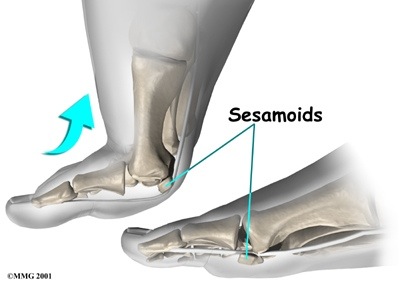
So here’s my story. I was just starting residency and had ran most of my life at that point. I had done 3 marathons and numerous other types of races and really just ran as a means of relaxation. In the year 2000, I developed pain in my right great toe in the region of my sesamoid bones (for those not understanding what they are, i’ll explain shortly). Initially I attributed it to playing ice hockey and my skates were tight and it placed increased pressure to the great toe joint. The problem was, it never resolved. After living with it for about 4 years, it finally cultivated in the winter of 2003 when I was on a run in the wintery snow of Erie, PA and the pain became so severe I could barely run. I had x-rays taken of my foot and found in addition to the bipartite tibial sesamoid knew I had, I now had a fractured fibular sesamoid to go along with it! I wore a boot for 3 weeks, and had to stop running. It never worked. It calmed it down and eventually I was able to run again, but the pain in this region persisted. I had worn holes out to the great to region in the fabric on the insides of my Birkenstock Clogs that I would operate and work in. Was I putting too much pressure here? I just figured I was limping from the pain and the region was wearing. I continued to run. I would have good months, and bad months. Eventually I went on to run several more half marathons, another full marathon, and other road races. My foot still hurt. I would try multiple custom orthotics, OTC semi-custom orthotics, and even various running shoes, but just couldn’t resolve it. I focused on “heel-striking” because that was what at that time I was “told” was the proper way to run. Imagine my frustration. A podiatrist, foot and ankle surgeon, who couldn’t fix his own foot. I had contemplated have the sesamoid removed but I felt that would be too destructive of a procedure because it is encompassed in the flexor hallucis brevis tendon and would create a ton of scarring and fibrosis. Not to mention that I was still able to run at times with no pain.
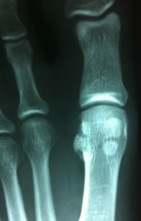
Notice the sesamoid on the left (lateral) is in 3 pieces and the sesamoid on the right (tibial) is in 2 pieces. (Dr. Nick’s Sesamoid Bones of right foot)
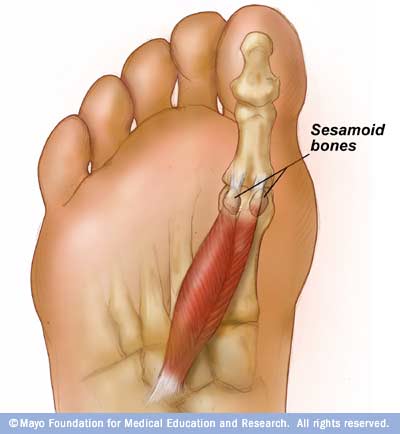
Notice how the sesamoid bones are intratendonous (within the tendon of the flexor hallucis brevis)
Enter 2009, the year when the questions starting pouring in about barefoot running. I was working an event for the Akron Marathon, when the owner of a local running shoe store (Vertical Runner) walked by wearing a pair of FiveFingers. I needed to put them on. I was getting bombarded with questions about them, and what better way then to have them on my feet to draw more attention to the matter. I wore them for the second half of the day with a suit and tie and fielded questions from the manny runners that walked by my booth. By the end of the evening, I had discovered that I was learning to stand differently because these shoes were killing my great toe! How could they possibly be good to run it? But that was just it. They forced me to stand differently. Had I been standing wrong in my other shoes? Absolutely, but I didn’t know it. I was wearing a pair of dress shoes that day, so of course my feet were going to hurt. But what did the shoe have to do withme standing wrong? I didn’t figure this out for at least another year.
I decided to focus a little more on barefoot running then just wearing a pair of FiveFingers. I started pulling the literature to understand this a little better. Surprisingly there wasn’t much out there on barefoot running. In fact most of it was anecdotal by an underground of runners who most would probably laugh at and never think much of it. But there was something about it. They weren’t getting injured and were running this way for years. That’s when I started pulling more and more literature on traditional cushioned running shoes. Surprisingly, there was not a shred of evidence to support prescribing these for running, foot pain, or any foot ailment that I had been treating and recommending them for. While all of this was happening, I had began transitioning to running in my FiveFingers. I will leave that story for another blog post!
After 8 weeksof transitioning, my sesamoiditis was all but gone! I just presumed it was coincidental as I had good months in the past, but never this long. How could this be? The treatment for sesamoiditis is to cushion the 1st MPJ, use a cut out offloading orthotic, or not run at all and rest it. I was, for all intensive purposes, running barefoot and mine resolved! Fast forward 5 months and I now completed a half marathon in a pair of FiveFingers and my sesamoiditis was 100% painfree.
Was it the shoes? Nope. I learned how to run. After another year or more of reading, learning (world wide collaboration of runners and physicians including Mark Cuccuzzella, Dan Lieberman, and Irene Davis) and now lecturing on this fascinating topic, I had finally got it. It has nothing to do with the shoes. It’s how you run. Yes I had strengthened my feet beyond what they had ever been my whole life, but the form I had now grown accustomed to was what was helping me.
So what does this have to do with fixing my sesamoiditis specifically? I took the pressure off of that area. This happened through a multitude of ways, but one that I think is most crucial is eliminating what most podiatrists and biomechanists used to describe as the “propulsion phase” of the gait cycle. By adapting a midfoot/forefoot strike pattern, with shorter strides,and landing with your foot below your body, the force that gets generated to the MPJ is reduced. You no longer pro-pulse with the great toe joint, but instead you drive forward with your thigh and the foot gets picked off the ground. There is a slight push off occurring with the foot, but its through the entire foot, not just the MPJ. So basically instead of pushing off with only your great toe, the entire foot takes the load minimizing the stress to great toe joint. This reduction in stress and force can allow the flexor hallucis longus and brevis tendons in the great toe joint to heal if they were inflamed which we typically refer to as sesamoiditis. This makes the condition more consistent with a tendonitis then a true boney pathology which can explain why many don’t respond to just simply resting the foot.






Thank you so much! This is an amazing blog post and I have already contacted a running coach to learn how to run properly. Thanks again, you’re awesome!
Hello! This blog post makes me very hopeful!!! I have sesamoiditis and a recent MRI showed that there is a lot of damage to the bone, although the doctor can’t tell if it is fractured or bipartite. ( He said the sesamoid bone on the outside is white or filled with fluid?) I started resting excessively bc the first podiatrist I saw said if I put too much pressure on it then I will damage it more. My present podiatrist has me in a boot for the next two weeks, but I was conflicted because I found that my feet felt the best walking around my house barefoot! However, if I go outside in normal thin soled shoes, the rest of the ball of my foot gets really sore. According to my current podiatrist, this is because it is compensating for the weight that would otherwise be on my first metatarsal. So at the moment, my number one shoes is Sanita(Dansko). Have you had any experience with those? I like them because they make it so that my foot doesn’t have to bend too much, when I’m outside walking around.
A question I have though, is would you say that this style of running you learned to offset the sesamoid is also relevant to how people walk? I hardly ever run, and so for me the issue is mainly while walking.
Thanks so much I appreciate your post a lot!
Dansko clogs can serve as a splint while your recovering. I do not recommend them as an everyday shoe when you recover because you need the flexibility. Also, they have a somewhat high heel which angles your foot and keeps you high off the ground. This makes you unstable. Correct if you don’t run you do have a different walking style. Try to take shorter steps and walk as if you were barefoot. You’ll eventually adapt. Start doing intrinsic muscle strengthening for your feet by using toes more. This will eventually resolve a tendonitis if that’s what your dealing with.
Thank you so much for the reply 🙂
You’re definitely right that the dansko shoes make my foot unstable. My ankle often rolls over, causing me to trip.
Over the past couple of months my foot has become very weak from all the resting! So I definitely think strengthening will be helpful. Especially since i’m flat footed.
One thing that is unclear to me is what you mean about how it is a tendonitis issue? Do you mean that it is the tendon causing the pain? How does the tendon make your bone fracture? And if is NOT a tendon issue, are you doing further injury to the sesamoid bone by learning how to walk barefoot? I know these are a lot of questions, so if you’d rather send me a scientific article or link, it would be much appreciated
I definitely need to do research on pose running/walking, because it does still confuse me about how I would distribute weight on my foot. When I walk barefoot, I feel like I just walk the same.
For the past week I have been in a boot, but I didn’t feel like it was doing anything. So yesterday I walked in my dansko shoes. And then this morning my feet felt really bad. (pain in sesamoid, and general stiffness for entire foot, especially the ball). Way worse than before I even put the boot on.
I’ve been dealing with this for almost a year now so I’m trying to remain hopeful that my foot will be normal again, and that this isn’t permanent and I appreciate all advice. Thank you very much
I really enjoy the way you relate an indepth medical topic to real world application. Thanks again for another great post!
Your welcome! Thanks for reading!!
Our stories sound similar, sort of. I’ve had sesamoid pain in my right foot since I was at least 12 (I’m now 23). It would worsen and heal off and on for 9 year until it got bad enough that I finally decided something wasn’t right. Two years ago I went into the orthopedist and through x-rays found I had bipartite sesamoid bones in both of my feet. The doctor said he didn’t think they were fractured, just bipartite. I was in a foot brace for 4 months, and during that time my sesamoiditis got about 50% better. I couldn’t afford the $400 orthodics at the time that my orthopedist recommended, so instead I bought the $45 superfeet orthodics for metatarsal support. When it felt like the pain had mostly gone away, I started running again.
Around this same time I learned about the barefoot running/vibram shoes and decided to try them even though I was told barefoot was the wrong way to go for sesamoiditis. I’m the kind of person that listens to my doctor’s advice 99.9% of the time, but I had no pain in them so I figured there was something he didn’t know or something magical about the vibrams. In addition to transitioning to the vibrams, I read a lot about running form and technique and made absolutely sure I was running correctly. I didn’t want to go back into the boot for another half a year!
Well, I ran (jog/walked while transitioning) pain-free (in my forefoot) for about 4 weeks when all the sudden my achilles-heel insertion began to hurt. I rested. And rested. And rested some more, but the pain in my achilles (left and right) never subsided. Fast forward to today, I’ve been in physical therapy for my achilles for several months. Things are slowly getting better, but it has taken an entire year for both of these tendons to partially heal (crap I’m getting my heals/heels mixed up!) I also have been wearing very supportive Asics shoes with heel pads (given to me by my physical therapist) AND the superfeet for metatarsal support.
This brings me back to my sesamoiditis. Now, the better my achilles pain gets, the worst my sesamoiditis becomes. If I wear shoes with heel support, it puts more pressure on my forefoot and after a week or so the pain becomes almost unbearable. However, I’m very very very hesitant to switch back to a minimalist style because my achilles pain is not completely gone. Did I transition to quickly to the vibrams at the start? Probably, and I regret it 1000%.
Needless to say, my feet always hurt. They always hurt and I’m tired of it. I’m a fairly physically active person. I don’t run marathons, but I run/walk/jog/hike to melt the stress off. Seeing as how I’m 8 weeks from graduating college, there’s a lot of stress, and reducing my physical activity is torture. I can’t become sedentary at 23. I’m frustrated with everyone: myself, my doctor, my orthopedist, my physical therapist, but mostly myself. I don’t understand why we can drive a car on mars and clone animals but can’t fix foot pain (although I sort of do, as I’m a biology major). It’s just frustrating.
If it was you in this situation, what would you do? Do I go back into my orthopedist and get the orthodics that may or may not help? Do I get a second/third/fourth opinion? Do I chop both my feet off and hope to god they can attach some sweet looking prosthetics?
Seeing as how I’ve had foot pain for the majority of my life, I’ve almost accepted the fact that this is forever. And honestly, that sucks! Thank you for this insightful post!
Oh my god i can relate SO MUCH to what you’ve just said. Which despite everything, makes me really happy. I’m so sorry for everything you are dealing with and I am currently giving you a cyber hug. I am also 23 years old, and I have great frustration over my now sedentary life due to sesamoiditis. My doctor also thinks that it is bipartite instead of a sesamoid fracture, so I’m hoping this is an accurate diagnosis. I recently got an MRI but it is still hard for him to tell for sure. Basically, I’ve had sesamoid pain since last summer, but it wasn’t until January of this year that I realized my feet need serious help. Since then I’ve spent much money on different shoes and insoles and a boot, and doctors appointments, and I feel like with every slight improvement there is another set back. Its like: 2 steps forward 3 steps back, one step forward, one step back, 3 steps forward 2 steps back…you get the idea. Fortunately, I feel like i am making improvement on my right foot, although my left foot is still in a boot. I can definitely relate to your speculative mentioning of getting prosthetic feet. With all my sesamoid pain I’ve been distributing weight to random parts of my feet. So my feet became painful all around and generally achy. Fortunately I don’t have too much heal pain, but I did have achiles tendonitis for two years. It was before I had sesamomiditis, and it was fine as long as I wore shoes with a heal. This is part of the reason why I am hesitant to switch to barefoot, bc I would expect the tendonitis to flare up from it bc I usually get one if i’m in any flat soled shoes. I am currently wearing dansko-esq shoes which although don’t provide a lot of stability for my ankle (they make my ankle role out sometimes), they do limit the movement to my sesamoid, and have a heel/rocker sole so they prob won’t bother your heal. I actually bought a pair of the sanita brand. It took 3 different pairs in different sizes to find the pair that actually fit me. Clearly, the barefoot was working for you, but maybe if you wore these until your heal gets better, it may prevent aggravation to the sesamoid, so it might provide a good balance. I have listed my current treatments below for sesamoiditis, which you’re probably aware of, but if not then check it out. And I’d appreciate any feedback from other people
1. Ice feet for ten minutes, and then soak in warm water (I have raynauds so I soak in warm water to keep up circulation.
2. Contrast baths 2x a day (soak in warm water for 4 minutes and ice water for 1 minute. Do that four times for a total of 20 minutes.
3. Massage arch with a massage ball (I have no idea if this is doing anything)
4. Stretch your legs. Apparently, you’re less likely to do damage to your feet if your legs are more flexible.
5. Rest a lot. Which is so much easier said than done when you simultaneously have to be alive.
6. I’m currently on an anti-imflammatory diet which is very similar to the cave man or paleo diet. And lots of omega 3s. I got a lot of info from this article:
http://www.huffingtonpost.com/dr-robert-a-kornfeld/5-ways-to-reduce-inflamma_b_271640.html
7. Help strengthen the muscles in that area. I have one flat foot so I am trying these exercises.
http://www.ehow.com/how_4550126_rebuild-arches-flat-feet.html
This is really dorky, but I feel like so much of this process is where I am emotionally. And I feel like this foot problem put me in a really dark place (hence dreams of prosthesis which is totally not cool!). And I really believe in holistic health, and if you can have a positive outlook, then you will encourage functions in your body that make you healthy, and that includes healing. I hate the movie The Secret because the movie itself sucks, but I watched it last weekend to atleast use positive imagery and optimism as a means to make myself more hopeful about healing my foot, vs. scan the internet for forums that should offer help, but instead freak me the hell out. Another good book is the happiness hypothesis, and I’d like to read a book on mindfulness, so that everytime my foot hurts I can be mindful instead of freaking out that it will never heal. I’m at the point where I’ve spent so much money on this, that I can’t even afford any more doctor appointments, so I’m expecting the time will be the best cure.
Anyway, let me know if any of this helps and I would love to hear about your progress. Feel free to post your email if you’d like to keep in touch about it that way. 🙂
Our stories sound similar, sort of. I’ve had sesamoid pain in my right foot since I was at least 12 (I’m now 23). It would worsen and heal off and on for 9 year until it got bad enough that I finally decided something wasn’t right. Two years ago I went into the orthopedist and through x-rays found I had bipartite sesamoid bones in both of my feet. The doctor said he didn’t think they were fractured, just bipartite. I was in a foot brace for 4 months, and during that time my sesamoiditis got about 50% better. I couldn’t afford the $400 orthodics at the time that my orthopedist recommended, so instead I bought the $45 superfeet orthodics for metatarsal support. When it felt like the pain had mostly gone away, I started running again.
Around this same time I learned about the barefoot running/vibram shoes and decided to try them even though I was told barefoot was the wrong way to go for sesamoiditis. I’m the kind of person that listens to my doctor’s advice 99.9% of the time, but I had no pain in them so I figured there was something he didn’t know or something magical about the vibrams. In addition to transitioning to the vibrams, I read a lot about running form and technique and made absolutely sure I was running correctly. I didn’t want to go back into the boot for another half a year!
Well, I ran (jog/walked while transitioning) pain-free (in my forefoot) for about 4 weeks when all the sudden my achilles-heel insertion began to hurt. I rested. And rested. And rested some more, but the pain in my achilles (left and right) never subsided. Fast forward to today, I’ve been in physical therapy for my achilles for several months. Things are slowly getting better, but it has taken an entire year for both of these tendons to partially heal (crap I’m getting my heals/heels mixed up!) I also have been wearing very supportive Asics shoes with heel pads (given to me by my physical therapist) AND the superfeet for metatarsal support.
This brings me back to my sesamoiditis. Now, the better my achilles pain gets, the worst my sesamoiditis becomes. If I wear shoes with heel support, it puts more pressure on my forefoot and after a week or so the pain becomes almost unbearable. However, I’m very very very hesitant to switch back to a minimalist style because my achilles pain is not completely gone. Did I transition to quickly to the vibrams at the start? Probably, and I regret it 1000%.
Needless to say, my feet always hurt. They always hurt and I’m tired of it. I’m a fairly physically active person. I don’t run marathons, but I run/walk/jog/hike to melt the stress off. Seeing as how I’m 8 weeks from graduating college, there’s a lot of stress, and reducing my physical activity is torture. I can’t become sedentary at 23. I’m frustrated with everyone: myself, my doctor, my orthopedist, my physical therapist, but mostly myself. I don’t understand why we can drive a car on mars and clone animals but can’t fix foot pain (although I sort of do, as I’m a biology major). It’s just frustrating.
If it was you in this situation, what would you do? Do I go back into my orthopedist and get the orthodics that may or may not help? Do I get a second/third/fourth opinion? Do I chop both my feet off and hope to god they can attach some sweet looking prosthetics?
Seeing as how I’ve had foot pain for the majority of my life, I’ve almost accepted the fact that this is forever. And honestly, that sucks! Thank you for this insightful post!
Thanks for your long comment! I feel your pain. Obviously I cannot diagnose or treat you through email but I will give some comments. Again this is not meant to be in place of you seeing a physician.
Sounds to me like your transition was too fast. Your Achilles will definitely take more stress as you learn to run this way. In fact, recent studies demonstrate a marked reduction in force to the knee with forefoot/ midfoot strike patterns which is transferred to the Achilles. But remember, the Achilles and gastrocsoleuos muscles can adapt to this stress over time and handle the force. The knee. (Or any joint) cannot. And, it’s not the FiveFingers doing anything directly. They just allow you to run naturally. Traditional running shoes prevent you from running with natural form. (My text explains this in simplistic terms if you haven’t seen it yet)
Again, I really can’t give you advice, but what I can tell you (and what I tell a lot of runners suffering from chronic injuries) is to reset your running and walking and standing. Meaning get into flat, flexible, light shoes that allow your feet to function the way they were designed. This can’t happen over night as it takes the body time to recover from it’s existing injury as well as adapt to its new way of functioning. It is recommended to wear this type of shoe gear an hour a day, gradually increasing an hour each week for 6-8 weeks at which one should be closed to being able to wear daily. It also helps going barefoot at home on the same manner through gradual increments.
Orthotics on this, and 95% of the time, can only work for temporary improvement. For orthotics should never be meant to be used indefinitely. They are a cast for your foot.
Hope this helps!!
Dr. Nick
hi dr nick,
your paragraph on walking helped me ALOT: pushing thru using the thigh, landing on mid/forefoot etc.. i’m having trouble standing though (i’m in the process of rebuilding myself after almost being in a wheelchair jan 2013).
what is your advice on standing? so far what i’ve done is 1. keep 3 points (triangle) on the foot in mind: under the big toe, under the pinkie toe, the heel 2. slight bend of the knees 3. focus effort on quads/hamstring/pelvis/lower back area. anything to delete/add?
you and dr ray mcclanahan are amazing for being the exception to the rule when it comes to podiatrists. thank you so much!
-cliff (san diego)
Thank you for the kind words!
As for standing, the less between your foot and the ground the better in regards to improving your proprioception- ability to feel the ground and send signal to brain which then sends it back to have feet adapt to ground.
The tripod description is correct, although I wouldn’t focus on obtaining it. Your foot should naturally obtain that position if your dispersing your weight appropriately.
Of course I can’t give medical advice, but I hope the helps!