

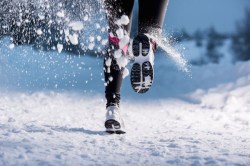
Some good tips for winter running from my Cleveland Clinic neighbors….
It’s the dead of winter and you’re thinking about going out for a run. But you’re also wondering whether training in the cold is a bad idea. Should you head out and brave the cold, or sit this one out? Anahad O’Connor, Well reporter, spoke to some experts to find out how to prevent issues from running in the cold.
Most experts say that any temperature, whether hot or cold, can present unique challenges. Running in the heat means you have to be extra cautious about dehydration, muscle cramping and the prospect of losing too much sodium in your sweat. Running in the cold means you have to worry about frostbite and other issues.
The key to running in any extreme temperature is to be prepared, says Dr. Laura Goldberg, a sports medicine doctor at the Cleveland Clinic and an avid marathoner. Dr. Goldberg is also a particularly big fan of cold runs. “I love running in the winter,” she said. “It’s beautiful and crisp and it’s great.” So what should you do to prepare?
Dr. Goldberg said that one of the biggest problems runners face in cold temperatures is the fact that cold muscles are prone to injury. “So the key is to warm up gradually,” she said. “And keep in mind that a lot of times you can’t quite run as fast in the cold.” Another problem with the cold is what it can do to your skin and your lungs. Breathing in cold air while you’re running could irritate your airway. It could provoke asthma or cause difficulty breathing, so it’s best to wear something that covers your mouth so that you’re not breathing in too much cold air. It’s also important to make sure that your skin is properly covered, by any means necessary. “If it’s very cold then I recommend covering your face,” Dr. Goldberg said, “even if it means using Vaseline.”
Run Well!
Jen A. Miller
Author, “Running: A Love Story”
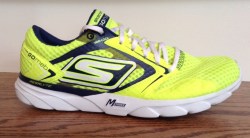
Shoe Name: Skechers GOrun Meb Speed
Model: Style #53568 LMBL
Weight: 7.5 oz
Price: $110.00
Drop: 4mm
Website: http://www.skechers.com/style/53568/skechers-gorun-meb-speed/lmbl
Forefoot: Features a wide forefoot, but not quite as wide as the Bionic and GOrun 2. With that said, I think it’s roomy enough to allow the toes to function independently. For a racing flat, it’s nowhere as narrow as the New Balance RC 5000 which caused my 4th and 5th toes to curl during each of the two marathons I ran in them. There is cushion in the forefoot which helps on the long runs and its firm yet still allows you to feel the ground and terrain. 
Cushion: I like the cushion better in this version as its a bit stiffer then both the Bionic and the GOrun 2. With a bit of a stiffer midsole, your foot is not working as hard to remain stable, yet there is still cushion to provide some comfort during a longer run such as a marathon. The GOrun 2 is too “squishy” for long runs and I find my foot musculature working harder. So I like the firmness of the midsole, which still lets you feel the ground but has cushion.
Flexibility: Not as flexible as the GOBioinc or GoRun 2 but still able to be rolled up. Is tough to say this is a true minimalist shoe, but its a great option to race a marathon in, or use as a training shoe for long runs. 
Overall: The shoe that was introduced for Meb Keflezighi. If its good enough for Meb, the. It’s good enough for me!! Just kidding, I don’t make comparisons as such, but this is without a doubt a performance shoe that is high end. If you want to race a marathon in it, I think it’s the shoe for you. It has has passed the GObionic on my Skechers favorite list. It is definitely more of a performance type shoe and I think would serve best as a marathon shoe. It may be too much “shoe” for a shorter race, that is for someone who is accustomed to running in a minimalist shoe.
I mentioned this before, but when I run longer with a more cushioned shoe I tend to feel my arch muscles (abductor hallucis, flexor hallucis brevis, and flexor digitorum brevis) working harder and fatiguing by the end of my run. A run over 10 miles becomes very noticeable with a softer shoe and I almost feel cramping in the arch.
Since writing this review, I’ve done several more runs in this shoe including an 8 mile tempo run (10 total) yesterday and I really enjoyed the feel. I’ve yet to pick a shoe for my upcoming Akron Marathon, but I’m leaning toward this one. I’ve ran my last two in the New Balance RC5000 which caused my 4th and 5th toes to cramp sound mile 18 as a result of its narrow toe box. The GOrun Meb is definitely wider and will not cause that. Stay tuned!!


If you caught Sharktank last night, you may have seen Stephen Sashan introducing his XeroShoes. These are an alternative to going barefoot that are catching on and becoming very popular. Similar to the Luna Sandals I blogged about already, these are a less expensive huarache designed for casual wear outside and even for running. I have witnessed a runner at my last marathon who completed the race in a pair of XeroShoes.
XeroShoes are a 4mm or 6mm rubber sole with a nylon string strap at can either be custom made to your foot by the company or cut by yourself. The nylon straps can be tied in various patterns or in the traditional huarache style. The do it yourself kit comes with a punch to go through the rubber for inserting the nylon strap.
I’ve worn then outside and found they are an excellent alternative to being barefoot but they are a challenge to lace. I have spent a considerable amount of time trying to lace and perfect my strap pattern with no real success. The straps are comfortable between toes, but not snug enough to keep your foot on the footbed as the comparable Luna Sandals. Having said that, I have done a 6 mile run in them and they felt great!
For the price they are a great sandal for outdoor use and minimalist/barefoot running. They even come with a 5,000 mile warranty!!


Since transitioning to minimalist shoes for running, I have attempted to replace my dress shoes and casual shoes with those that are in essence minimalist shoes. My longing to find a sandal that can be worn casually as well as to run in have finally come to an end. I have discovered the Luna Sandal. My colleagues that I lecture with on running as well as those that own running shoe stores have been running in and selling Luna sandals, I just never gave them a try. Mark Cuccuzzella, MD (physician, elite runner for Newton Running, creator of the Natural Running Center, and owner of Two Rivers Treads running shoe store) wears and runs in Luna Sandals.
Luna’s are a huarache type sandal which incorporates foot straps that wrap the rearfoot and uses a strap between the great toe and 2nd toe in the forefoot. They are similar to the XeroShoes, that are huaraches, but are much better quality and construction. I’m not discrediting the XeroShoes, as they are a good option for the price, but the more expensive Luna’s are better constructed and offer a much simpler and comfortable strap that requires very little adjusting.
They offer several styles but my choice was the popular Venado with the Pittards High Performance Leather footbed. This leather foot bed is comfortable and soft against the skin and conforms over time. The sole is a 6mm Vibram rubber sole that offers mild cushioning yet still allowing you to feel the ground. My favorite part of these sandals by far is the strapping system.
 It’s a high quality nylon that has several unique characteristics. The area between the toes is tubular for comfort.

The straps are flattened on the bottom of the sole where they exit so they are not felt by your foot. Rubber texture is incorporated into the strap so there is no slipping between the grooves in the sole yet still allowing for adjusting when before placing on your foot. The rearfoot strap has elastic qualities allowing mild give while putting on the sandal.

I have been wearing them casually and love them. Took them out for a 6 mile test run and they were perfect!! No slippage and no irritation between toes or any other areas.
This is the most ideal sandal that is universal for every activity!!
You can purchase them here a www.lunasandals.com.


“But I wear good shoes” is a common phrase I hear from my patients. Daily. What exactly are these good shoes?
Day after day I continue to hear patients voice their concerns to me that they cannot reduce their foot pain despite the fact that they’re buying “good shoes”. Is there really such a thing as a good shoe? Is spending $250-$300 on a popular brand-name men’s dress shoe, going to solve your problems of foot pain?
Even if you have realized its the shoes that’s causing your problem, is it really possible to go against society’s rules of what we wear to work and in public?
Many times these patients who present with chronic heel pain and have tried orthotics, physical therapy, stretching, night splints, NSAIDs, and cortisone injections yet have lived with the pain for years. Why? I feel the explanation is rather simple. They are creating the problem. Well, indirectly because society has created it for them. These patients are forced to wear shoes. Shoes that have been created to satisfy socioeconomic status and not to fit a human foot. Consider men’s dress shoes. They are stiff, narrow in the forefoot, unnaturally angles with a 3/4 inch solid block heel and are heavy. I don’t think there is a male out there who loves wearing them. I use to tell people if you can’t run a marathon in the shoes your wearing, you probably shouldn’t be wearing them. Dress shoes can be worn for 8 hours a day or more translating into a 40 hour week of placing your foot into this unnatural device compared to running a marathon for 4 hours in a running shoe. 40 hours weekly!!! Not many people run a marathon weekly with daily mileage combined. The problem lies in what their wearing all week long at work. What should these patients wear?
An even more complex patient is the mechanic or machine operator who is required by regulations to wear steel toe boots. Often these boots are very stiff and rigid which again cause the foot to become compromised with respect to mobility and range of motion leading to a weakened (atrophied) foot from lack of use of the intrinsic foot muscles. Again, very challenging to explain to these people that it’s their occupation related shoe gear creating the issue.
Of course we can’t leave the female dress shoes out of this discussion. In a previous post I mentioned that its common place to see women at weddings taking off those 4 inch heels so they can dance. “I have to get these things off my feet…..” becomes a popular phrase heard after a formal event.
So who is to blame? The shoe? The patient? Society? I have no idea, I just know that our foot was masterfully engineered to function the way it was designed. As soon as we place the foot in an unnatural position in the manner that most shoes do, problems begin to occur. I’m not saying our society should be running around barefoot, but I think we could do a lot better in choosing what we put on our feet.
To answer the popular question of, “What’s the best shoe I can get for my feet?”. It’s one that allows your foot to function the way it was intended to.

A recent study published in the June edition of Journal of Pediatric Orthopaedics examined the effects of heavy cushioned heel running shoes on competitive track athletes. They compared their gait in large heeled trainers to how they ran in racing flats and barefoot. Greater then 70% of the runners had a heel strike with the cushioned shoe which was not present less then 30 percent of the time in the other conditions. Runners adopted a more natural forefoot / midfoot strike pattern when running barefoot or with racing flats. The conclusion, training in heavily cushioned trainers by the competitive runner has not been clearly shown to be detrimental to performance, but it does change the gait pattern. They go on to suggest that It is not known whether the altered biomechanics of the heavily heeled cushioned trainer may be detrimental to the adolescent runner who is still developing a running style.
Knowing the detrimental effects heel striking has on the body without shoes, this study coincides with the philosophy that traditional running shoes can interfere with a natural running gait leading to the possibility of increased injury and decreased efficiency.
As reported on www.RunnersWorld.com.
Ryan Hall in Costa Rican Half May 26
He’s returning to what he calls his “happy place.”

Ryan Hall will return to Costa Rica, what he calls his “happy place,” the scene of his honeymoon with wife, Sara, to run the inaugural Media Maraton Gatorade – the Gatorade Half Marathon – in the capital city of San Jose on May 26.
Hall, who has the American half-marathon record of 59:43, has made no mention of this Costa Rica race on Facebook or Twitter, both of which do mention his May 19 appearance at the Bay to Breakers 12-K in San Francisco. There’s been no press release in English about his trip to this 13.1-miler. But Hall has made a video discussing the Media Maraton, and it’s included in a write-up about Hall at the Spanish-language Una Vuelta a la Manzana website in an entry by Marianella Cordero.
Cordero, who can be seen posing with Hall, refers to him as “un muchacho de 30 años con un talento fenomenal para correr, y una enorme dosis de humildad y trabajo para sostener esos resultados y seguir mejorando.” It’s been 45 years since I took high school Spanish, but she means Hall is “a young man of 30 with a phenomenal talent for running, and an enormous amount of humility and work to sustain his results and continue improving.” Or thereabouts.
In his video, Hall, who withdrew from the April 15 Boston Marathon, says “I’m really excited to be running my first half marathon of the 2013 season in Costa Rica.” He praises the Central American nation’s food, people, and coffee, and explains, “I’m just really looking forward to running a good half marathon. I’m not sure what kind of shape I’m in. I haven’t raced yet this season but [have] been training hard and feeling good in my running so I’m excited to go and test myself.”
See my latest interview for Men’s Health which discusses how to safely transition your running style. We help to clarify the myths of injury associated with minimalist shoes.
Should You Switch Running Shoes?
by Brian Dalek May 16, 2013, 04:18 pm EDT

Is it time for a change?
Think twice before switching your sneaks. Changing to less cushioned running shoes could cause you to overexert certain parts of your legs and feet, says a new study in the Annals of Biomedical Engineering.
In an analysis of 19 runners, researchers at the University of Wisconsin-La Crosse found that those who landed on their forefoot experienced 11 percent more force on their Achilles each step compared to those who landed on their heel. That’s about 7,000 extra pounds of force over a mile for a 150-pound runner, researchers say.
What’s going on? The Achilles tendon and calf muscles take on a greater load with forefoot strikers than a heel strikers, who transfer more of their landing energy to muscles like the quadriceps, says study author John Willson, Ph.D. It’s not wrong to land this way—just a different force for each landing pattern.
Running barefoot or in minimalist shoes can lead you to land more on your forefoot, putting your Achilles and calf at some risk if they’re weak. So the key is to transition gradually. Start with these tips from Nick Campitelli, D.P.M., a board-certified podiatrist in Akron, Ohio who runs drnicksrunningblog.com.
MORE USEFUL STUFF
Follow The 10 Percent Rule
If you typically run 20 miles per week, designate a total of 2 miles to running in your minimal shoes, then build on that each week. Like slowly adding weight to your bench press, your body can respond to that 10 percent increase. “It might only be 3 minutes at the start of your run, then put your other shoes on and continue to run in those,” says Campitelli. But avoid adding those miles to the end of your run; your muscles are fatigued by then, making it hard to practice the new form properly.
Be Patient
You could try running a 5K after a few weeks, but you may be asking for trouble. “When I transitioned, I hit 10 miles after 6 to 8 months, and I still think that was too fast,” he says. If you’re an aggressive heel striker, it could take several months up to a year to truly transition.
Monitor Your Pain
Lingering pain in your Achilles, the top of your foot, or lower calf is initially common because you’re using your foot differently. If pain goes away once you warm up during a run, you should be okay—it’s likely just normal running achiness. But if pain stays around all the time or worsens as you run, it could be something like a stress fracture, says Campitelli.
Strengthen Your Foot
Do 100 calf raises, which strengthen both calf and foot muscles, throughout the day. Concentrate on dispersing the weight on your entire forefoot, forming an arch and gripping the ground with your toes.



 Dr. Nick's Running Blog