
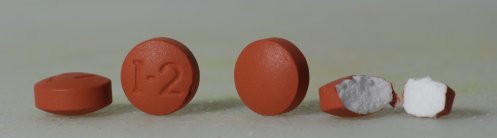
It very common for runners to begin taking over the counter medications in efforts to relieve the pain of an overuse syndrome. The thought is that because they are over the counter they are safe and have no real detrimental side effects. This is not true for several reasons. First, patients tend to take the medications at doses that are prescription doses because the frequently double up after googling what is recommended by a physician. Secondly, patients become dependent on them because the pain is being masked or improved and the underlying cause of the injury is not being addressed.
What is the difference between Tylenol and NSAIDS?
Tylenol, or acetominophen, is an analgesic and only reduces pain not inflammation. It also has antipyretic effects – reduces fever. NSAIDS, such as ibuprofen (Advil) and Naprosyn (Alleve) work by reducing inflammation which also helps to reduce the pain associated with the overuse injury. NSAIDS are better in resolving an issue because they treat the inflammation, but again the root of the problem needs to be addressed. A downside to NSAIDS is that they can have detrimental effects on the stomach lining leading to bleeding and ulcerations. Celebrex is prescribed NSAID that does not effect the stomach and is safer theoretically then taking ibuprofen.
Ultimately, treating the underlying cause of the injury is the most effective way at improving your pain. Do not rely on these OTC medications to cure you. Tylenol is much safer then taking ibuprofen when used on an as needed basis but if the condition does not resolve after a week of taking either medications, seeking a physician would be more beneficial then continuing the medication.
See the below video on the differences between Tylenol and NSAIDS.

Running. The best medicine.
I am often questioned why I wake up so early to run or how I find time to run so much. It’s not easy, but once you get started and feel the benefits it has to offer, it’s difficult to stop. Waking up at at 5:20 AM was not something I would have ever imagined I would be doing. Years ago, and before kids, most of my runs were in the evening or as late as 10 o’clock at night. When kids entered our life, it became a challenge to keep this schedule. Making the change to AM runs was the only option. It took some getting used to (psychologists say it takes 40 days of doing something for it to become habit), but morning runs are an outstanding way to start the day.
This past week I unexpectedly lost my father. Without a doubt this was one of the hardest things to go through and anyone who has can certainly understand. For me, there was no better way to cope or no better medicine then to run. It has become such a part of my life that stopping would be harder then it was to start. The calming effect it has and health benefits are priceless. Endorphins (“endogenous morphine”) are endogenous opioid peptides that function as neurotransmitters and are produced by the pituitary gland and the hypothalamus in during exercise. They resemble the opiates in their abilities to produce analgesia and a feeling of well-being. The term implies a pharmacological activity analogous to the activity of the corticosteroid category of biochemicals. The word endorphin means a morphine-like substance originating from within the body.
Running has been proven to:
– boost your immune system
– increase the levels of good cholesterol
– increase ling function
– decrease risk of blood clots
– reduce risk of breast cancer in women
– decrease risk of a heart attack
– help to maintain constant weight
– boost confidence
– reduce stress
– eliminate depression
– reduce the risk of stroke
– lower blood pressure
– treats diabetes
– reduce risk of osteoporosis
What many people fail to understand is that running does not have to be hard. Just increasing your heart rate to what is considered an aerobic rate will provide these benefits. Aerobic zones of training can be sustained my many for hours. As an example, this would be a pace where you could carry a full conversation without stopping for a breath. If you can’t breath, your running too hard.
Running is the best form of medicine. Period.
Below is a great article I read this morning and wanted to share with everyone. Makes us runners think about why we do, what we do!
“Daddy, where are you going?” my son asked me recently as I was lacing up my running shoes on a cold, wet Sunday morning. “Running,” I said. “Why?” he asked.
He’s only three. But it was a good question, and one I couldn’t readily answer. I didn’t really want to go. My body was still jarring from the shock of being hauled out of its cosy bed. I was training for a marathon, sure, but it was still months away. Right at that moment, it didn’t feel critically important to be heading out into the unruly winter morning. I could go later. Or the next day. Or just not run the marathon. Why was I even running a marathon? But something was making me go. “Because it’s fun,” I said, rather unconvincingly.
The truth is, just before you run is the worst possible moment to try to explain to someone, or even to yourself, why you run. It just doesn’t make sense. Running is hard. It requires effort. And after all the pain you usually end up right back where you started, having run in a big, pointless circle.
Often people say to me they can run if they’re chasing a ball, but to just run, nothing else, just one foot in front of the other, well, they find it too boring. I listen and nod, not sure I could convince them otherwise, even if I tried. Running doesn’t have logic on its side.
Of course, some people run to lose weight, or to get fit, and these are great reasons. Running is also easy to do, it’s cheap, and you can do it when you want without having to book a court or rustle up a team. All these factors certainly contribute to the fact that running is one of the most popular sports in the UK, with more than two million people in England running at least once a week, according to Sport England.
But for many of those two million runners, the real reason we head out to pound the roads until our legs hurt is more intangible than weight loss or fitness. I remember, as a keen runner in my youth, constantly correcting people who asked me if I was running to get fit. “No,” I would say. “I’m getting fit to run.” I may have thought I was being clever, but for me and many others, running has its own inherent raison d’être. What that is, however, is harder to put your finger on.
Many runners become obsessed with times. The need to break the 40-minute barrier for the 10K, for example, or run under four hours for the marathon, can become the all-conquering reason. There is something reassuring about striving towards such fixed goals, measuring your progress in numbers that are not open to interpretation, but stand there as unambiguous achievements in an otherwise confusing world. Yet, really, these numbers are so arbitrary as to be almost meaningless. And as soon as they are achieved, another target is thrown out almost instantly.
A runner I know last year trained with intense dedication with the goal of running a marathon in less than three hours. In the end he ran three hours and two minutes. Afterwards I spoke to him expecting him to be distraught at coming so close. On the contrary, he was pleased.
“I’m actually glad,” he said. “If I’d done it, that would be it. Now I’ve still got my target, I can try again next year.”
No, the times themselves are not the reason we run mile after mile, up hills, in wind and rain, when we could be still cosy in bed, or relaxing with a drink in the pub. The times are merely the carrots we dangle in front of ourselves. We’re like little Pacmen chasing PBs (personal bests), gobbling them up before looking for more. But why do we dangle them there in the first place.
“Why do we do this to ourselves!” It’s a common refrain at running clubs up and down the country. Usually I hear it as I’m about to head out to run with a group of men and women in fluorescent tops, a sense of foreboding mingling among us in anticipation of the pain we’re about to put ourselves through. But nobody ever gives a sensible answer. It’s a rhetorical question. Deep down, we all know the answer.
Running brings us joy. Watch small children when they are excited, at play, and mostly they can’t stop running. Back and forth, up and down, in little, pointless circles. I remember, even as an older child, I’d often break into a run when walking along the street, for no reason. There’s a great moment in The Catcher in the Rye when Holden Caulfield, caught in the uneasy space between childhood and adulthood, is walking across his school grounds one evening and he suddenly starts to run. “I don’t even know what I was running for – I guess I just felt like it,” he says.
This will to run is innate. In fact, humans may well have evolved the way we did because of our ability to run. Christopher McDougall’s bestselling book Born to Run is largely based around a theory devised by Harvard scientists that humans evolved through persistence hunting – chasing animals down until they dropped dead. It’s why we have Achillies tendons, arched feet, big bums, and a nuchal ligament at the back of our necks (to keep our heads still as we run). While even Usain Bolt would be left trailing in a sprint against most four-legged mammals, over long distances we are the Olympic champions of the animal kingdom. If they could keep them in sight for long enough, our ancestors could catch even the swiftest runners such as antelope just by running after them.
Indeed, the great Kenyan runner Mike Boit told me the story of how his village held a celebration for him after he won the 1978 Commonwealth Games. He was showing off his medal when his old childhood friend came up to him and said: “That’s all very good, but can you still catch an antelope?”
But while as children, and even adolescents, we can respond to this natural urge to run and break into a trot whenever the feeling takes us, as adults it’s not the done thing to just start running at any moment, without any reason. So we formalise it. We become runners. We buy running kit. We set out our carrots (our targets), we download iPhone apps, we get people to sponsor us (so there’s no backing out), and once everything is set up, finally we can run.
Racing along out on the trails, or even through the busy streets of a city, splashing through puddles, letting the rain drench us, the wind ruffle us, we begin to sense a faint recollection of that childish joy. Somewhere a primal essence stirs deep within us; this being born not to sit at a desk or read newspapers and drink coffee, but to live a wilder existence. As we run, the layers of responsibility and identity we have gathered in our lives, the father, mother, lawyer, teacher, Manchester United-supporter labels, all fall away, leaving us with the raw human being underneath. It’s a rare thing, and it can be confronting. Some of us will stop, almost shocked by ourselves, by how our heart is pumping, by how our mind is racing, struggling with our attempts to leave it behind.
But if we push on, running harder, deeper into the loneliness, further away from the world and the structure of our lives, we begin to feel strangely elated, detached yet at the same time connected, connected to ourselves. With nothing but our own two legs moving us, we begin to get a vague, tingling sense of who, or what, we really are.
In Japan, the monks of mount Hiei run up to 1,000 marathons in 1,000 days in an attempt to reach enlightenment. I once stood by the roadside at around mile 24 of the London marathon, watching as person after person ran by, almost every one of them at a point in their lives they would rarely visit again. It was almost like seeing into their souls, their faces grimacing and contorted, but also alive with the effort. Each one of them soon after crossing the line would be glowing with a sense of wellbeing. Some may even be moved to tears by it (I was after my first marathon). It’s the fabled runner’s high, of course, but by labelling it such we diminish it. It may only be chemicals shooting around in your brain, but after a long run everything seems right in the world. Everything is at peace.
To experience this is a powerful feeling, strong enough to have us coming back, again and again, for more.
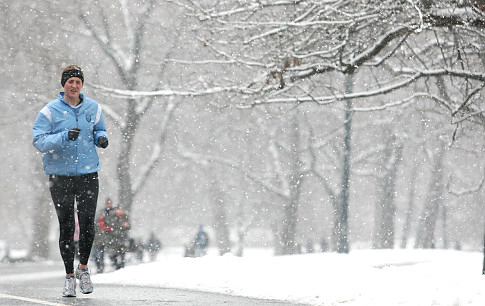
- Know where you’re running. Having a route selected ahead of time will save you from being cold for longer than you planned. Always make a habit of checking the local weather and road conditions before heading out, so you know exactly what to expect. You’ll be sure to have a more enjoyable run!
- Wicking layers are your friends. Materials like polypropylene will draw the sweat away from you. This is a good thing, because that moisture will freeze and make you cold if it’s next to your body for any length of time. Don’t wear cotton, since it traps moisture and keeps you wet and cold. Gore-Tex or nylon works for your outer layer, since it breathes and shields you from precipitation and wind. You can also add a middle layer of fleece to stay extra warm.
- Hydration is key. Even though it’s cold, you still need to quench your thirst. The body heats up when it’s active, and you’ll run the risk of losing fluids through your sweat. Be sure to drink plenty of water before you head out, when you’re running, and of course after.
- Protect your extremities. Running gloves are great for wicking moisture away on milder days, and gloves are perfect for those extra-cold days. You know those instant heat packs? Stuff them into your gloves for added warmth. For your feet, choose a wicking sock or a liner to wear under your regular socks.
- Wear the right shades. Protect your eyes! If it’s a clear, sunny day, wearing sunglasses can prevent the sun from glaring off the snow. Choose a comfortable pair of polarized running glasses. You’ll be glad you did!
- Cover your noggin. Nearly 40 percent of body heat will escape from your head, so make sure you wear a wicking beanie to regulate your body’s heat better. A scarf or balaclava also works during those extra-cold days.
- Check with your doctor first. Even if you’re in tip-top shape, ask your doctor if you can handle running in freezing temperatures. Cold air may trigger asthma attacks or even chest pain, so take an extra few minutes and ask first.
- Don’t overdress. Things will get nice and toasty once you start running, so a few sensible layers is really all you need.
- Carry a phone. Just in case you run into trouble, you’ll be glad you brought your cell phone along. If your top layer has a chest pocket, take your phone and place it in a plastic sandwich bag and put it in that pocket. That way, once you start sweating, your phone won’t get all wet from the sweat.
- Change out of your wet clothes promptly. If you’re outside and it start snowing or raining, or you’re extra wet from sweating, you run the risk of hypothermia. Bring along a backpack with an extra layer or two, and take shelter quickly.
Running in the winter gives you the chance to enjoy beautiful surroundings, quiet landscapes and a nice change of pace for your exercise routine. If you make the necessary preparations, you’ll be sure to have a more enjoyable time!
Borrowed from : Tips for Cold Weather Running originally tweeted by Pittsburgh Marathon.
In case you missed the Superbowl last night, Skechers debuted a commercial featuring there new running shoe the GO2run. You can view it by clicking below.
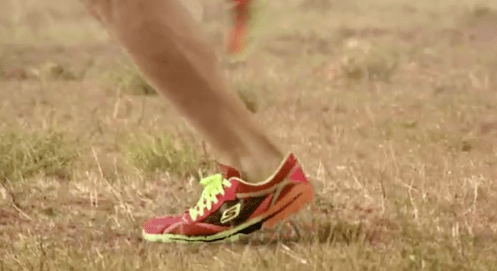
Click to see Skechers Superbowl Commercial
Most wouldn’t think of Skechers as a company to produce a running shoe, but they are making some waves with the new Performance Division of Skechers. The GOrun, GOrun2, and GObionic runnings shoes have been extensively engineered to allow the foot to work as it was designed and permit a midfoot strike while running. The GOrun series features a 4mm heel height and the GObionic is a zero drop shoe designed more for racing. Both feature a wide toe-box allowing the to toes to move freely and are very lightweight in design. The flexible sole allows for unlimited range of motion for the foot and ankle with ability to still feel the ground. This is an excellent minimalist shoe that in my opinion surpasses the Nike Free by far.

In November I attended The Running Event in Austin, TX where I as asked to discuss foot strengthening with the company Hygenic (makers of Theraband and Biofreeze). Here I was given a copy of the book, The Hansons Marathon Method: A Renegade Path to Your Fastest Marathon, and had a chance to meet the author Luke Humphrey. Humphrey is an exercise physiologist and has also utilized the Hanson’s training principals to qualify for several Olympic Trials Marathons and a marathon PR of 2:14:39. Coaches, as well as brothers, Kevin and Keith Hanson’s marathon plan is outlined and discussed by Luke Humphrey.
One of the unique aspects of this plan is that it doesn’t have runners doing the popular 20 mile long runs in preparation for the Marathon. In fact, the longest run is only 16 miles. Their philosophy is based off of the training principals of famous New Zeleand running coach Arthur Lydiard who was a proponent of logging high mileage. How can that be if the longest run is only 16 miles? There are several important aspects to consider. Even though the longest run may be 16 miles, the rest of the week’s mileage will easily add up to 50 plus miles. In most traditional beginner plans, a runner may be logging 50 miles, but roughly 40% of that is performed on one day in the long run. Here’s a quote from Runner’s World discussing the training program.
The Hansons’ schedules are based on the philosophy that no one workout is more important than another. “On some schedules, you rest the day before and after the 20-miler,” says Kevin. “That’s putting too much emphasis on one workout. And for someone whose weekly mileage is going to top out at 50, it means they’re doing 40 percent of their running in one day.” To people who question whether the elite Hansons-Brooks athletes do longer runs, he replies, “Sure, they’ll do a 20 to 22 miler, but it’s part of a 130-mile week. So it’s actually a smaller percentage of their total volume than it would be for someone doing less mileage.”
Something else to consider is that other programs typically have you resting on the day before and after a long run. Hanson’s program will have you approach your long run with three 3 days worth of fatigue making the run feel like the last 16 miles of a marathon.
I haven’t read the book in it’s entirety, but from what I have read, it certainly offers more to gain then from following the popular Hal Higdon programs. I feel those programs focus too much on long runs and short track workouts with less overall mileage. Even the advanced programs feature track workouts at the beginning which is when runners should be focusing on building a base with aerobic training. I do still think heart rate training needs to be incorporated as many runners do not understand pace and running easy. Easy running is really more important then speed work when trying to build endurance to become faster.
Humphrey’s book is available at Amazon and is also in ebook format for the iPad and Kindle.
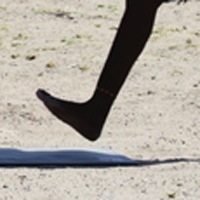
The article below was written by Amby Burfoot from Runners World and discusses a new study published that shows not all habitually barefoot runners land with a forefoot or midfoot strike. These results demonstrated at speeds of 9:00 to 13:24 minutes per mile, the subjects were heel striking. As their speeds increased to a 5:21 pace, heel strike lessened to 43 percent. While these are interesting findings it is still extremely difficult to say that one particular foot strike is the best for all runners.
Without a doubt, we know it is wrong for a runner to strike the ground with an outstretched leg and heel first. When the foot lands below the body (or more scientifically speaking the body’s center of gravity or close to it) the spring mechanism can be engaged this reducing the impact force. The true debate is when this form is achieved does it matter whether the heel is striking or the midfoot is striking. To compare forefoot to midfoot is also difficult. Definitely being too far up on the toes is incorrect and leads inefficiency. A relaxed strike with the midfoot is more efficient with respect to energy utilized to achieve the form.
The full article by Amby Burfoot is available here:
The study can be read in its entirety here:
http://www.plosone.org/article/info%3Adoi%2F10.1371%2Fjournal.pone.0052548
New Study Reaches Different Conclusion On Kenyan Foot Strikes
The question: What’s the “natural” way to run?
By Amby Burfoot
Published
January 10, 2013
Three years ago, a Harvard team including evolutionary biologist Daniel Lieberman, Ph.D., published a paper in Nature showing a high percentage of forefoot striking among Kenyan runners, adults and adolescents, who had grown up barefoot. The paper led many to conclude that humans had evolved to be forefoot/midfoot runners, and not rearfoot runners.
Now a research group from George Washington University has conducted a similar analysis of another group of habitually barefoot Kenyans, and reached the opposite conclusion. Among 38 barefoot Daasanach tribe members from northern Kenya (19 men, 19 women), 72 percent landed on their rearfoot when running barefoot at a self-selected, comfortable pace.
The GWU team did confirm one central Lieberman finding. “Our data support the hypothesis that a forefoot strike reduces impact loading,” they wrote. Nonetheless, “the majority of subjects instead used a rearfoot strike at endurance running speeds.”
The GWU data also supported the notion that running speed affects landing. When their Daasanach subjects increased speed, they were more likely to land on the midfoot or forefoot. At the slowest speeds (9:00 to 13:24 per mile), 83 percent of runners landed on their rearfoot. At speeds faster than 5:21 per mile, this decreased to about 43 percent.
Many of Lieberman’s barefoot (and forefoot-striking) Kenyan subjects were running at sub-5:00/mile pace. By contrast, his “habitually barefoot” running U.S. subjects averaged 6:52 pace. See the tables below for data from both studies.
The GWU team believe that many other factors could influence preferred running style. These include “training level, substrate mechanical properties [ie, running surface, hard or soft], running distance and running frequency.”
The question of running speed becomes important because, from an evolutionary perspective, it should answer this question: What running speed would have put the most calories on the dinner table? Did Paleo runners survive by going relatively long and slow, or with shorter, faster bursts? Little is known about this subject.
The Daasanach live on the northern reaches of Lake Turkana in Kenya, bordering Ethiopia and Sudan. They are a small tribe with little or no running history. Lieberman’s study was conducted with Kalenjin runners in and around Eldoret, Kenya, about 300 miles from the homeland of the Daasanach. Many of Kenya’s fastest, most famous runners come from the Kalenjin tribe.
GWU Study, 2013: Percent Rearfoot Strikers (All Barefoot)
Rearfoot %
Speed, range (pace per mile)
Daasanach
83
8:56-13:24
Daasanach
68
6:42-8:56
Daasanach
73
5:21-6:42
Daasanach
43
4:28-5:21
Harvard Study, 2010: Percent Rearfoot Strikers (All Kenyans barefoot)
Rearfoot %
Speed, average (pace per mile)
Kenyan adults
9
4:32
Kenyan teens
25
4:52
U.S. barefoot
12
6:52
U.S. shod
83
6:42

A recent patent filed by Apple Inc. in July 2012 describes a sensor and alarm system that can be embedded into footwear, granting users a more empirical method on which to rely when deciding to replace worn-out shoes. Sounds interesting. Maybe 20 years ago. Steve Jobs, who was known for introducing products that were ten years ahead of what all the other tech companies were doing, would never have considered a product of this nature. Clearly the literature and research being discussed today is not leaning towards increased injury rates as shoes “wear out” or lose cushion. In fact, studies have demonstrated that as cushion is lost, control is actually gained. The previous thinking of replacing shoes after 300-500 miles was based on a single study from 1985 by Cook et al and was never discussed in literature again.
I was a huge Steve Jobs fan and still watch videos of his keynotes and interviews to learn and understand his way if presenting and thinking. In my eyes, it is sad to see Apple focusing effort on a product of this nature. Jobs has been notorious for saying that Apple introduces products for people’s needs, before people actually realize that they need them. Somehow I don’t think this fits the mold for a “Job’s Product”.
Below is my article that was published in the January 2013 issue of Podiatry Management. It was written on behalf of the American Academy of Podiatric Sports Medicine and I am honored that Podiatry Management agreed to publish it. It is very exciting to see our profession begin acknowledging that footwear does not have as much to do with injury as we previously thought. Enjoy and spread the word!!
Nicholas A. Campitelli, DPM, FACFAS
Podiatrist, Foot and Ankle Surgeon
Running injuries can be very frustrating for physicians as they can be extremely time-consuming, and stereotypical runners will not curtail their running to resolve an injury. If you tell a runner not to run, most of the time, s(he) will not listen to you and not follow through with your prescribed treatment regimen. This challenge leads many physicians to not treat runners. Added to this frustration is the recommendation of footgear. Whether someone has been running for many years or just starting out, the runner tends to place a lot of emphasis on what shoes to wear. Form is traditionally ignored. Runners, as well as practitioners, will typically make a change of shoes in an attempt to fix an injury.
What most practitioners do not realize is there is no evidence-based literature existing on recommending a running shoe to prevent or reduce injuries.(1-8) Following the popular paradigm of recommending a running shoe based on foot type leads to frustration as there are numerous models being introduced frequently. When we dissect the reasons that we use a particular shoe, the situation becomes even more blurred. There is no clear scientific basis for using one particular shoe model over another for given foot types or pathologies, despite what some manufacturers claim.(1) The term “appropriate shoe” is a misnomer when viewed by the outdated paradigm of selecting a shoe according to arch type, and many are still advocating shoes this way. Even the implementation of orthotics has little if any bearing on reducing or correcting injuries in runners.(9-12)
We also live in a society where people incorrectly believe they have a flat foot or over pronate. Associated with this is the stigma that foot types (especially flat feet) influence injury patterns.(13) This, however, is not true.(14) Evidence suggests that training patterns actually play more of a role in increasing the incidence of running injurious.(15,16) The key is understanding that form and training patterns play more of a role on improving one’s running and at the same time reducing injury.(17)
Common Approach to Running Injuries
Before seeking treatment for an injury, most runners will run through pain thinking that it will eventually resolve. When it finally becomes too severe to continue, medical advice is usually sought. The standard protocol for a physician or sports medicine specialist treating a runner is as follows: 1. Question athletes about how many miles a week they are running 2. Evaluation of footgear 3. The number of miles on the current footgear 4. Biomechanical assessment of feet and lower extremities. If the runner is seen in a more specialized clinic, a gait analysis is sometimes performed. Overpronation is commonly diagnosed, and an effort to control this excessive motion is usually attempted with orthotics. High tech scans and pressure analysis may also be performed, although very little if any applicable information can be generated from this.
Form analysis, on the contrary, focuses more on the runner’s style with respect to foot strike, cadence, and the runner’s overall body posture. It is slowly becoming the panacea to help improve someone’s running and reduce or resolve injuries.(17,18) Runners tend to develop injuries as a result of poor or incorrect form and overuse which many times overlap.(15,19) Debate exists as to what is the “proper form” for running. Proper form will certainly vary from one runner to the next making each runner’s form “ideal” for that individual. There are, however, certain aspects of form a runner should strive to attain – adequate foot strike, cadence, and posture.
Foot Strike
Foot strike is the first aspect that needs to be addressed. There is a common misunderstanding that all aspects of gait, whether walking or running, should begin with a heel strike. Following heel strike, the force is carried laterally, transversing medially upon which it is increased at the 1st MPJ where the propulsion phase ends the final stage of the stance phase before leading into toe off.(20) Much of this thinking is attributed to Root, et al. Over the years, this idea has somehow carried over to running.(20)
The practitioner sometimes will examine the footgear to see if any wear patterns exist that would indicate increased pronation as indicated by wear seen more medially on the heel than laterally. The problem with this pathway is that we have no evidence-based studies to indicate heel striking is the correct way to land when running. In fact, recent studies demonstrate higher injuries among collegiate cross country runners that heel strike as compared to those who forefoot strike.(21,22)
Numerous studies have compared shod and unshod runners and a forefoot strike pattern is adapted among those who run without shoes.(23-27) We all see that elite runners tend to forefoot strike more than slower recreational runners as demonstrated by Larson, et al.(28,29) Evidence exists that the human body has a natural tendency to fore-foot or mid-foot strike when running barefoot or in minimalist shoes.(23,26)
Heel Strike vs Forefoot/Midfoot Strike
By striking the ground with the heel first, the subtalar joint takes the brunt of the force leading to possibly over-utilizing the posterior tibial tendon. We also see that during a rearfoot strike, the forefoot (including the toes) and midfoot joints really serve no purpose in absorbing shock. If, instead, we utilize these joints with a forefoot or midfoot strike, the entire foot can pronate instead of only the subtalar joint which can achieve more absorption of the impact force.(30). By avoiding heel strike, one can utilize the rest of the foot to absorb shock.

Figure 1 – (Top photo)- Heel-striking results in increased force being transmitted to the lower extremity. (Bottom Photo) – By adapting a foot strike, the lower extremity can absorb shock naturally and reduce the impact force.
When we forefoot or midfoot strike, we can control the amount of pronation innately by activating our musculature (Figure 1). Consider that one common complaint of those who make the transition to minimalist shoes is “calf pain.” This is due to the activation of the gastroc-soleus, posterior tibial, flexor digitorum longus, and flexor hallucis longus muscles in efforts to slow the heel from striking the ground. They are contracting eccentrically to “slow pronation”. This does not need to be scientifically demonstrated in “future studies” as we already know that if pronation of the foot is dorsiflexion, eversion, and abduction, then these
muscles collectively are contracting as they are lengthening in order to “slow” pronation. As they become strong enough, they will control the pronation that is occurring during foot strike.(31,32)
Running Shoes
Examining the categories of traditional running shoes reveals that manufacturers have created them according to three foot types – flat foot, normal arch, and high arch. The AAPSM has defined the categories as maximum stability, stability, and neutral. For example, ASICS defines their stability category shoe as “Structured Cushioning.”(33) According to ASCIS, “the structured cushioning is designed for runners who pronate slightly more than normal and generally have a normal arch.”(33) This infers that the runner is heel striking. Otherwise, why would there be a need to control motion? Some of the normal pronation that is encountered when a runner forefoot or midfoot strikes could be inhibited by this motion-controlling apparatus.
Why then are running shoes created with a thick cushioned heel and motion control support? That question is debatable, but it is clear that over the past 40 years we have seen no reduction in injury rates and marathon times have remained unchanged. Many physicians still abide by the rule of changing your shoes every 300-500 miles. This became popular after a study in 1984 that demonstrated shock absorption loss after 250-500 miles of running.(34) Since then, studies have actually demonstrated as absorptive qualities of a shoe are lost, the foot becomes more stable leading to the likelihood of reduced injury with more mileage.(35-37)
At the same time, the notion that runners with a high arch “need a great deal of shock attenuation because they don’t absorb shock naturally through pronation,” implies that we need to pronate to absorb shock. It becomes extremely crucial to look at pronation on terms of the entire foot as opposed to only the subtalar joint because more shock attenuation can be achieved utilizing the forefoot and midfoot.
Even if we consider implementing an orthotic into the shoe to control pronation, we have to consider the goal of this. The orthotic for an over-pronator is typically designed to control motion at the subtalar joint that results in increased pronation. With forefoot striking, we have to look at this from an entirely different perspective in which the orthotic would not serve the same purpose; therefore, its use is of question.
Landing
Where the foot strikes in relation to the rest of the body is also crucial. To increase efficiency and reduce shock to the lower extremity, the foot should be landing under the body’s center of gravity or close to it. This engages the body’s natural spring mechanism by utilizing eccentric contractions of the muscles at the ankle, knee, and hip, during landing (Figure 2). In contrast, heel striking with the leg reaching in front of the body’s center of gravity results in the leg impacting in an extended position increasing the force to these joints (Figure 3). Even if one heel strikes with the foot below the center of gravity, one will lose part of the spring as the reduction of direct force by its conversion to rotational force through the ankle is lost.

Figure 2 – To increase efficiency and reduce shock to the lower extremity, the foot should be landing under the body’s center of gravity or close to it. This engages the body’s natural spring mechanism by utilizing eccentric contractions of the muscles at the ankle, knee, and hip during landing.
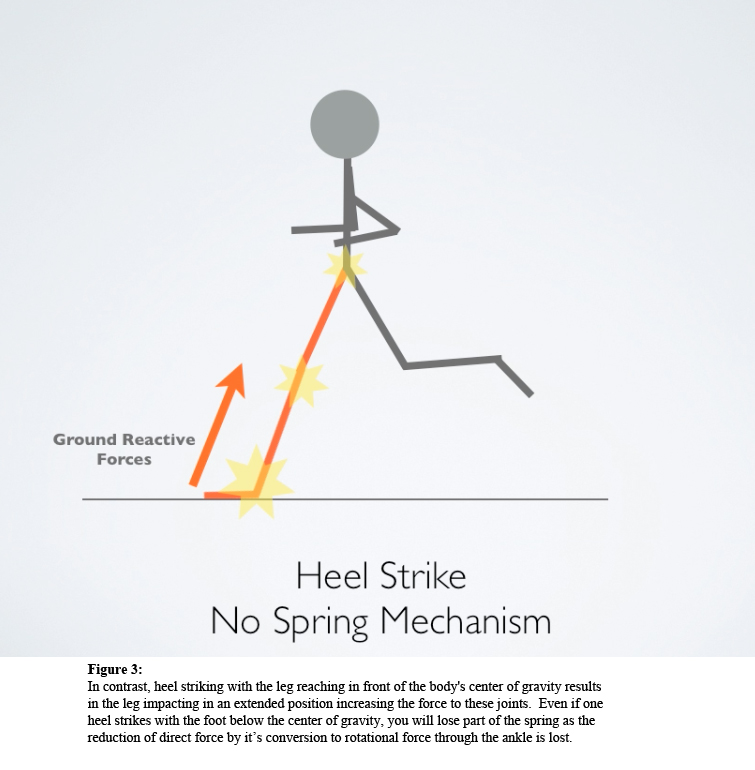
Figure 3 – In contrast, heel striking with the leg reaching in front of the body’s center of gravity results in the leg impacting in an extended position, increasing the force to those joints. Even if one heel strikes with the foot below the center of gravity, you will lose part of the spring, as the reduction of direct force by its conversion to rotational force through the ankle is lost.
Cadence
Cadence is another piece to the puzzle. Cadence is the number of steps a runner takes per minute. Examining elite runners and marathoners, it has been determined that achieving a cadence of 180 steps per minute or higher will result in increased efficiency.(38) Running with a forefoot strike pattern makes it easier for one to increase cadence.(23) This high cadence keeps the runner closer to the ground reducing vertical motion that is associated with increased impact forces. (23) Shorter strides are associated with a higher cadence, but as speed increases the stride length will also increase.(23,27,32) It is important to understand that cadence should not vary with speed. For example, if running a 10 minute mile or slower, cadence should remain at 180 or greater. Faster paces such as 5:00 to 6:00 per mile can sometimes reach cadences of 200 or greater. The key is to understand that shorter strides and faster turnover will increase efficiency and reduce ground reactive forces.
Posture
Finally, the body’s overall posture also needs to be assessed. This can be somewhat confusing because some running instructors advise to keep an upright posture while others will advise to “lean forward.” Both are actually correct. The body’s overall position should be erect, but it should be falling forward. The term “leaning” should not occur at the waist such as bending over but the entire body should be angled forward (Figure 4). Running in place and then leaning forward to begin movement will help to teach this concept. This increases efficiency by utilizing forward momentum as opposed to decelerating with each step which recruits more musculature.

Figure 4 – The body’s overall position should be erect, but it should be falling forward. The term “leaning” should not occur at the waist, such as bending over, but the entire body should be leaning forward. Running in place and then leaning forward to begin the movement will help to teach this concept. This increases efficiency by utilizing forward momentum, as opposed to decelerating with each step, which recruits more musculature.
Conclusion
Focusing on these steps discussed will help to improve a runner’s efficiency leading to reduced injury. New Balance has partnered with Kurt Munson, a well known running shoe retailer from Michigan, and created the educational concept known as Good Form Running.(18) Good Form Running teaches these steps in a simplistic manner, and specialty running shoe stores across the United States are holding clinics to instruct this.
Interestingly, children tend to run this way when they are unshod and playing outside.(39-41) The younger they are, the more noticeable this is as their gait has not been altered by wearing footgear. As for pediatric shoes, America Academy of Pediatrics recommends not wearing shoes until it is necessitated by the environment.(42) This helps to encourage natural foot motion, thereby enabling adequate development and strength gains.
A final point that is crucial in mentioning is training patterns. Most recreational runners and even elite runners tend to train too hard.(17) Improving the body’s aerobic capacity means to continuously train at an aerobic rate.(17) This is best achieved through the use of a heart rate monitor. Training too much at too high of a heart rate can lead to overuse injuries.(17) Runners too often focus on maintaining a pace instead of listening to their body and their training becomes borderline anaerobic.(17)
Obviously there is more to running than discussed here but having this, as a foundation, really helps anyone just beginning running or even those who have been running for many years. It is crucial for physicians treating running injuries to understand this.
In conclusion, it seems that most practitioners are straying from the path of helping a runner by focusing on shoes as opposed to form. The term “appropriate shoe” is a misnomer when viewed by the old paradigm of selecting a shoe according to arch type, and many are still advocating shoes this way. A running shoe should allow the foot to function as it was designed to – naturally without inhibiting motion. Adding cushioned heels and motion control mechanisms can inhibit this. By viewing shoes as the first line of treatment for most conditions, we must make sure this does not interfere with the foot’s natural function.
The shoe should feel comfortable initially (not with time) without a need for the foot to “get used to the pressure pushing against the arch.” A gradual adaptation to this way of running is obviously needed or injury can result as our feet and bodies may have been accustomed to a different form and supportive shoe. The approach is very similar to creating a program for someone just beginning to run.
References
1. Knapik JJ, Trone DW, Swedler DI, Villasenor A, Bullock SH, Schmied E, Bockelman T, Han P, Jones BH. Injury reduction effectiveness of assigning running shoes based on plantar shape in Marine Corps basic training. Am J Sports Med. 2010 Sep;38(9):1759-67. Epub 2010 Jun 24.
2. Clinghan R, Arnold GP, Drew TS, Cochrane LA, Abboud RJ. Do you get value for money when you buy an expensive pair of running shoes? Br J Sports Med. 2008 Mar;42(3):189-93. Epub 2007 Oct 11.
3. Butler RJ, Hamill J, Davis I. Effect of footwear on high and low arched runners’ mechanics during a prolonged run. Gait Posture. 2007 Jul;26(2):219-25. Epub 2006 Oct 20.
4. Kerr R, Arnold GP, Drew TS, Cochrane LA, Abboud RJ. Shoes influence lower limb muscle activity and may predispose the wearer to lateral ankle ligament injury. J Orthop Res. 2009 Mar;27(3):318-24.
5. Marti, B. (1998). Relationships between running injuries and running shoes—results of a study of 5,000 participants of a 16K run. The Shoe in Sport. Chicago: Year Book Medical Publishers. 256–265.
6. Herzog W. Running injuries: is it a question of evolution, form, tissue properties, mileage, or shoes? Exerc Sport Sci Rev. 2012 Apr;40(2):59-60.Yeung SS, Yeung EW, Gillespie LD. Interventions for preventing lower limb soft-tissue running injuries. Cochrane Database Syst Rev. 2011 Jul 6;(7):CD001256. Review.
7. Yeung SS, Yeung EW, Gillespie LD. Interventions for preventing lower limb soft-tissue running injuries. Cochrane Database Syst Rev. 2011 Jul 6;(7).
8. Clinghan R, Arnold GP, Drew TS, Cochrane LA, Abboud RJ. Do you get value for money when you buy an expensive pair of running shoes? Br J Sports Med. 2008 Mar;42(3):189-93. Epub 2007 Oct 11. PubMed PMID: 17932096.
9. Gross ML, Napoli RC. Treatment of lower extremity injuries with orthotic shoe inserts. An overview. Sports Med. 1993;15(1):66-70.
10. Stackhouse CL, Davis IM, Hamill J. Orthotic intervention in forefoot and rearfoot strike running patterns. Clin Biomech (Bristol, Avon). 2004;19(1):64-70.
11. Mattila VM, Sillanpää PJ, Salo T, Laine HJ, Mäenpää H, Pihlajamäki H. Can orthotic insoles prevent lower limb overuse injuries? A randomized-controlled trial of 228 subjects. Scand J Med Sci Sports. 2011 Dec;21(6):804-8. doi: 10.1111/j.1600-0838.2010.01116.x. Epub 2010 May 12.
12. Kilmartin TE, Wallace WA. The scientific basis for the use of biomechanical foot orthoses in the treatment of lower limb sports injuries–a review of the literature. Br J Sports Med. 1994;28(3):180-4.
13. Hohmann E, Reaburn P, Imhoff A. Runner’s knowledge of their foot type: do they really know? Foot (Edinb). 2012 Sep;22(3):205-10. doi: 10.1016/j.foot.2012.04.008. Epub 2012 May 18.
14. Michelson JD, Durant DM, McFarland E. Injury risk associated with pes planus in athletes. Foot Ankle Int 2003;23(7):629–933.
15. Hespanhol Junior LC, Costa LO, Carvalho AC, Lopes AD. A description of training characteristics and its association with previous musculoskeletal injuries in recreational runners: a cross-sectional study. Rev Bras Fisioter. 2012 Jan-Feb;16(1):46-53.
16. van Gent RN, Siem D, van Middelkoop M, van Os AG, Bierma-Zeinstra SM, Koes BW. Incidence and determinants of lower extremity running injuries in long distance runners: a systematic review. Br J Sports Med. 2007 Aug;41(8):469-80; discussion 480. Epub 2007 May 1. Review.
17. Maffetone, Philip. The Big Book of Endurance Training and Racing. Skyhorse Publishing. 2010 Sep 22.
18. http://www.goodformrunning.com
19. Edwards WB, Taylor D, Rudolphi TJ, Gillette JC, Derrick TR. Effects of stride length and running mileage on a probabilistic stress fracture model. Med Sci Sports Exerc. 2009 Dec;41(12):2177-84.
20. Root ML, Orien WP, Weed JH. Normal and Abnormal Function of the Foot -Volume 2. Clinical Biomechanics Corp., Los Angeles, CA, 1977
21. Goss DL, Gross MT. Relationships Among Self-reported Shoe Type, Footstrike Pattern, and Injury Incidence. US Army Med Dep J. 2012 Oct-Dec:25-30.
22. Daoud AI, Geissler GJ, Wang F, Saretsky J, Daoud YA, Lieberman DE. Foot strike and injury rates in endurance runners: a retrospective study. Med Sci Sports Exerc. 2012 Jul;44(7):1325-34.
23. Lieberman DE, Venkadesan M, Werbel WA, Daoud AI, D’Andrea S, Davis IS, Mang’eni RO, Pitsiladis Y. Foot strike patterns and collision forces in habitually barefoot versus shod runners. Nature. 2010 Jan 28;463(7280):531-5.
24. Morley JB, Decker LM, Dierks T, Blanke D, French JA, Stergiou N. Effects of varying amounts of pronation on the mediolateral ground reaction forces during barefoot versus shod running. J Appl Biomech. 2010 May;26(2):205-14.
25. Eslami M, Begon M, Farahpour N, Allard P. Forefoot-rearfoot coupling patterns and tibial internal rotation during stance phase of barefoot versus shod running. Clin Biomech (Bristol, Avon). 2007 Jan;22(1):74-80. Epub 2006 Oct 17.
26. De Wit B, De Clercq D, Aerts P. Biomechanical analysis of the stance phase during barefoot and shod running. J Biomech. 2000 Mar;33(3):269-78.
27. Robbins SE, Hanna AM. Running-related injury prevention through barefoot adaptations. Med Sci Sports Exerc. 1987 Apr;19(2):148-56.
28. Larson P, Higgins E, Kaminski J, Decker T, Preble J, Lyons D, McIntyre K, Normile A. J Sports Sci. 2011 Dec;29(15):1665-73. Epub 2011 Nov 18.
29. Hayes P, Caplan N. Foot strike patterns and ground contact times during high-calibre middle-distance races. J Sports Sci. 2012;30(12):1275-83. doi: 10.1080/02640414.2012.707326. Epub 2012 Aug 2.
30. Nigg BM. The role of impact forces and foot pronation: a new paradigm. Clin J Sport Med. 2001 Jan;11(1):2-9. Review.
31. Feltner ME, MacRae HS, MacRae PG, Turner NS, Hartman CA, Summers ML, Welch MD. Strength training effects on rearfoot motion in running. Med Sci Sports Exerc. 1994 Aug;26(8):1021-7.
32. Ardigò LP, Lafortuna C, Minetti AE, Mognoni P, Saibene F. Metabolic and mechanical aspects of foot landing type, forefoot and rearfoot strike, in human running. Acta Physiol Scand. 1995 Sep;155(1):17-22.
33. http://www.asicsamerica.com/Shoe-Fit-Guide/
34. Cook SD, Kester MA, Brunet ME. Shock absorption characteristics of running shoes. Am J Sports Med. 1985 Jul-Aug;13(4):248-53.
35. Kong PW, Candelaria NG, Smith DR. Running in new and worn shoes: a comparison of three types of cushioning footwear. Br J Sports Med. 2009 Oct;43(10):745-9. Epub 2008 Sep 18.
36. Hamill J, Bates BT. A kinetic evaluation of the effects of in vivo loading on running shoes. J Orthop Sports Phys Ther. 1988;10(2):47-53.
37. Rethnam U, Makwana N. Are old running shoes detrimental to your feet? A pedobarographic study. BMC Res Notes. 2011 Aug 24;4:307.
38. Daniels J. Daniels’ Running Formula. Champaign, IL: Human Kinetics, 2005.
39. Wolf S, Simon J, Patikas D, Schuster W, Armbrust P, Döderlein L. Foot motion in children shoes: a comparison of barefoot walking with shod walking in conventional and flexible shoes. Gait Posture. 2008 Jan;27(1):51-9. Epub 2007 Mar 13.
40. Wegener C, Hunt AE, Vanwanseele B, Burns J, Smith RM. Effect of children’s shoes on gait: a systematic review and meta-analysis. J Foot Ankle Res. 2011 Jan; 4:3.
41. Wolf S, Simon J, Patikas D, Schuster W, Armbrust P, Döderlein L. Foot motion in children shoes: a comparison of barefoot walking with shod walking in conventional and flexible shoes. Gait Posture. 2008; 27(1):51-9.
42. Hoekelman RA, Chianese, MJ. Presenting Signs and Symptoms. In: McInerny TK, Adam HM, Campbell DE (eds.) American Academy of Pediatrics Textbook of Pediatric Care, 5th edition, American Academy of Pediatrics, Elk Grove Village, IL, 2.
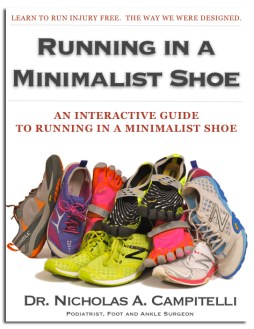
Editor’s note: The images contained in this article are borrowed from Dr. Campitelli’s interactive text, Running in a Minimalist Shoe and cannot be reproduced or borrowed without permission.
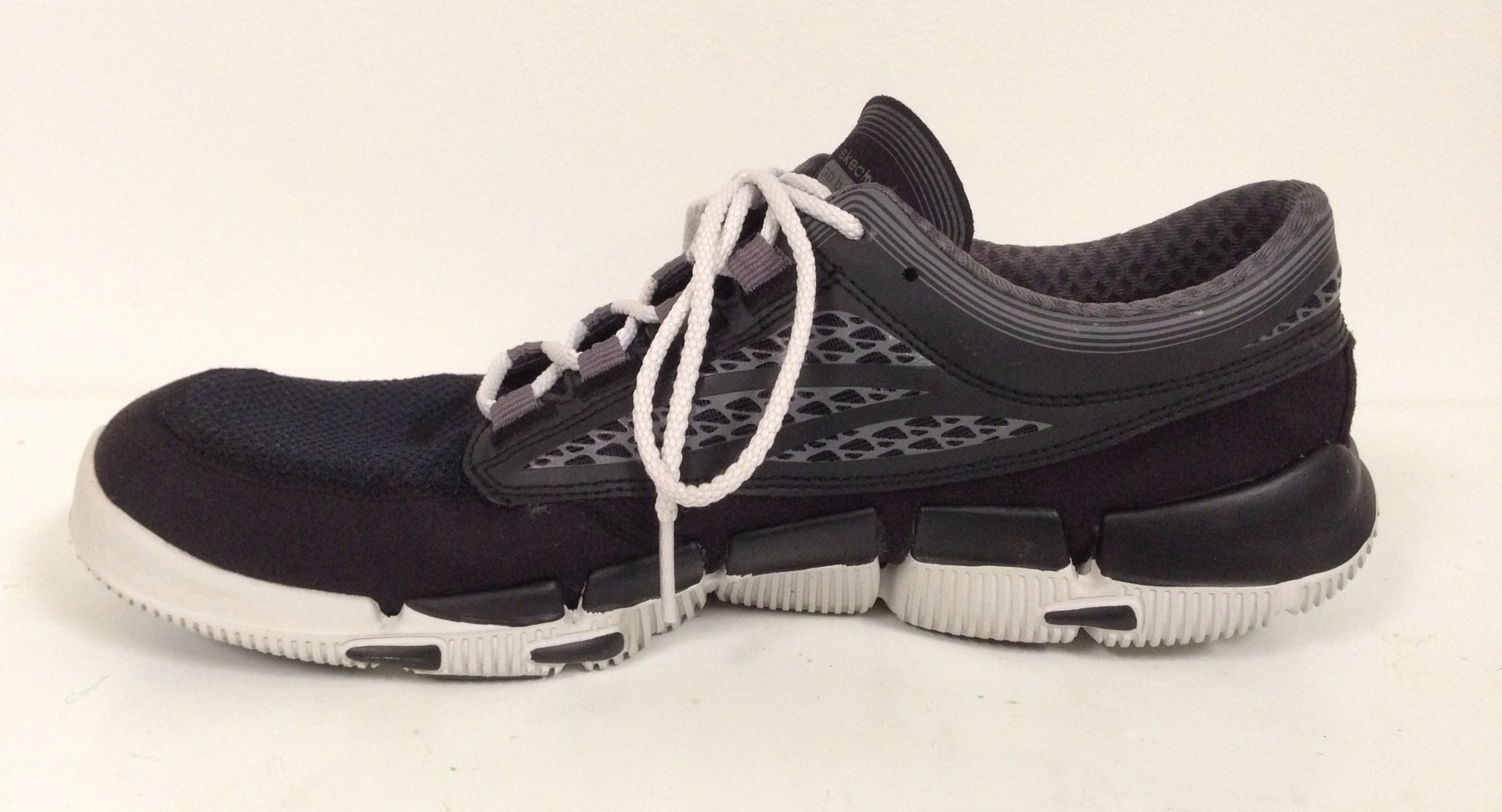
Shoe Name: Skechers GObionic
Model: GObionic
Weight: 6.0 oz for size 9
Price: MSRP $80.00
Drop: zero 0mm
Website: http://www.skechers.com/styles/performance/gobionic
Forefoot: Excellent wide forefoot with a design that makes it appear to be the width of a traditional shoe. It’s almost as if its an optical illusion!! Really a soft comfortable upper fabric allowing toes to move freely. Also, the sole is flexible to allow the toes to wiggle and bend etc.
Cushion: Perfect amount of cushion! Especially spoken from someone who loves Vibram FiveFingers and logs the majority of his miles in them! The ability to still feel the ground is present yet enough cushion to wear for an 18-20 mile run (in fact not a bad shoe for a marathon) The inside liner pulls out for more of a “barefoot” feel as Skechers” describes it. The shoe rests on its midfoot instead of sitting completely flat which encourages the midfoot strike.
Flexibility: Excellent flexibility by ability to be rolled up as well as twisting. Definitely allows natural foot motion to occur.
Overall: I am overly impressed with this shoe. In my opinion, Skechers has gone from a casual shoe manufacturer to creating one of the best minimalist shoes on the planet. USA Marathoner Meb Keflezighi trains and competes in Skechers. This shoe is without a doubt worth considering for those transitioning to a minimalist shoe or even for those who want a racing shoe for a longer distance race that has a bit of cushion. I would (an probably will soon) wear this for a
marathon.
UPDATED REVIEW
By Julie (36 y/o runner)

I have been running in a minimalist shoe for over a year. When I transitioned from traditional to minimalist, I quickly began in the New Balance Minimus. I loved my Minimus shoe so much that I trained and ran two marathons in the same shoe.
I am not one who is up for changing my running routine, and especially my footwear. It was a big stretch to even transition into a minimalist shoe! However, Nick was really excited about the Sketchers new minimalist shoe, GObionic, and he wanted my opinion about them. Of course I was willing to give it a try because I wanted to see for myself if they truly were as good as he thought they were. I tried them out 3 weeks ago. When I slipped the shoes on, I immediately noticed how light and “foamy” they were. It felt as if I was wearing a really comfortable pair of slippers. They were extremely comfortable and I noticed that I wouldn’t need to “break” the shoes in. It’s like they were made for my feet. I ran 6 miles the first day I tried them. I felt that my feet were getting a break from the super flat and harder minimalist New Balance shoe. I liked them so much that I ran 10 miles in the GObionics the very next day. My feet felt great. I liked the bright hot pink color and the laces stayed tied double knotted for the entire run.
For my current marathon training, I switch up my runs between the New Balance Minimus and the GObionics. The GObionics give me a little bit more cushion that the New Balance lack. I think the GObionic would be a great shoe for the traditional shoe runner who is looking to transition to a minimalist shoe. This would be the perfect shoe to try out.










 Dr. Nick's Running Blog