
I figured this is a good time to repost my article written for the periodical Podiatry Today as it appears that our story hungry media journalists can not comprehend the information delivered in the recent study, published last month in Medicine & Science in Sports & Exercise. Below is the article in it’s entirety which may help straighten out the thinking of these individuals.
-Dr. Nick

Confused Media
Tackling the 10 Myths of Barefoot Running
Barefoot running, minimalist running, and natural running are all terms that describe running in a manner that allows our foot to function the way it was designed (or has evolved) through the use of little or no shoe at all. Many runners suffering from chronic injuries are adopting this way of running and are experiencing relief of symptoms to find themselves running with enjoyment and relaxing form. I too have been cured of a running injury that I suffered from for over 8 years after transitioning my gait to that of a “barefoot” runner. When I was asked to write this article I couldn’t wait to get the chance to share all of my research and experience on this rather “new” way of running. However, I only have 1500 words so without further do, here are the 10 myths of barefoot running.
- Stress Fractures: Without a doubt the most common concern with barefoot or minimalist running is the development of a stress fracture. While there have been documented cases of this in the literature, it occurs as a result of a change in activity without gradual adaptation and not directly related to the shoegear or lack of (1). We actually should see a decrease in the likelihood of stress fracture given the change in stride and cadence that one acquires while running in this manner (2). Stress fractures occur secondary to overuse without the body having adapted adequately, as proven by Wolff’s Law (3). In fact if we adhere to Wolff’s law, in theory we should see weaker bone trabecular patterns on those wearing cushioned running shoes due to decreased intrinsic muscle strength resulting in a proportional decrease in the force acting on the respective bone (4).
- I have flat feet and I need support: Lees and Klemerman have demonstrated that there is no correlation between foot type and running injuries, specifically with a pes planus deformity (5). During barefoot running we avoid heel striking and land more on our forefoot or midst foot. Once the forefoot strikes the ground, pronation of the entire foot begins (not isolated pronation of the subtalar joint) and continues until the point where the heel touches the ground. Arch height becomes irrelevant as does the commonly described concept of pronation with the heel striking the ground first. With a forefoot/midfoot strike, pronation is very beneficial and helps to absorb shock.
- I weigh too much: While a common excuse to not run, this does not hold true for reason enough to not run barefoot or in a minimalist shoe. Leiberman et al in 2010 were able to demonstrate that habitually unshod runners were able to generate smaller collision forces then shod heel strikers (6). In other words, by forefoot striking, we decrease the force that is transmitted through the lower extremity thereby reducing torque forces to the ankle, knee, and hip joints (7). Clearly we can see that if a person weigh 250 lbs, they would be placing more force through their joints by heel striking then by landing on their forefoot.
- I have bad knees: Osteoarthritis of the knee is a common concern amongst many runners, especially upper aged individuals who have run the majority of their lives. There are many theories as to why running is bad or even good for your knees. So many in fact that elliptical machines were invented to be used as a form of exercise similar to running without causing excess pressure to the joints (8). These “ellipticals” however do not reproduce anatomical motions and we see that when in vivo force analysis were performed there is less force with walking then with an elliptical trainer (9-11). As discussed previously we know that GRF are greater with heel strike as compared to unshod or barefoot runners who adapt a more forefoot strike pattern (6). Numerous studies have demonstrated higher GRF and mechanical stresses to the knee while running in traditional running shoes as opposed to barefoot(12-13). A recent study published in British Jounal of sports Medicine looked at subjects with knee osteoarthritis over 12 months and found no difference with wearing a lateral wedge orthotic vs a control flat insert (14). Similarly a systematic review of literature demonstrates that external knee adduction moment and pain associated with knee osteoarthritis is increased in individuals wearing sneakers as compared to barefoot walking (15).
- I can’t because I need to wear my orthotics: Orthotics have become more over utilized in the practice of podiatry then ever before. It is very common for me to see runners present in my office with plantar fasciitis, have a normal arch, wearing cushioned running shoes, and have been given orthotics. When running barefoot or in a minimalist shoe, we do not need to control motion at the rearfoot because heel striking is not occurring and “excessive pronation” as described by root does not occurr. While we have numerous studies that do not support the use of orthotics for running injuries alone, it becomes a challenge to convince the patient it is not needed (16-20).
- I have plantar fasciitis, this would be too painful: This article was not intended to discuss the pathomechanics or treatment options of plantar fasciitis, however, we are anecdotally seeing resolution of symptoms in those who adopt this style of running. One potentially explanation is the development in strength we see to the intrinsic musculature, specifically the abductor hallucis muscle which is a primary supporter of the arch (21-25). Another overlooked phenomenon is the fact that the majority of running shoes place your ankle into plantar flexion which forces the body to compensate by increasing lumbar lordosis as well as increasing pressure to the heel as opposed to more evenly distributed throughout the foot.
- My fat pad is atrophied: This is another common myth that patients acquire from various sources, including medical professionals. Most, if not all, of us have experienced a patient who complains of forefoot pain or calluses and then simply blame the problem on lack of adipose tissue or cushioning below the metatarsal heads. While those seems a possible etiology, to date we have no evidence that the fat pad of the sole of our foot actually atrophies on the forefoot or the heel region (26,27). With common forefoot pathology such as hammertoe deformities, we do see the fat pad migrate distally producing more prominent metatarsal heads, but typically this is in severe cases, ie rheumatoid arthritis (28). Patients at this stage of a deformity are typically not runners.
- You will get severe calluses: Calluses on our feet form as a result of shear fore on the plantar surfaces of the skin that produces excess friction. Shear force that occurs in the horizontal plane is the key to understanding this. Direct pressure does not produce calluses or we would see a high preponderance of heel calluses in runners as the majority of runners heel strike. Root discussed the formation of forefoot calluses secondary to shearing forces associated with propulsion as well as to the central metatarsals due to increased loading for an excessive period of time and abnormal shear (29). Root’s observations hold true for someone who heel strikes when running, as we see increased force placed upon the forefoot during what he described as the propulsion phase. Observation of the gait of barefoot runner or one that strikes with the forefoot/midfoot demonstrates that the propulsion phase as described by root becomes very minimal in existence if even at all. Good Form Running in association with New Balance provides training to adopt this style of running and we can see that by developing forward momentum, we carry the contralateral limb forward instead of pro-pulsing with the forefoot (30). By doing this we decrease the force present to the forefoot, especially the shear force. Not only is this beneficial for reduction of the shear force, but we see a decrease in the ground reactive forces acting on the 1st MPJ which can reduce sesamoiditis.
- I run long distance and can’t do that barefoot: What many of us fail to realize is that we have been running for thousands of years and without going into the debatable discussion of evolution, we know that early runners began running either barefoot or with very minimal shoegear such as moccasins (31). In 1960, Abebe Bikila won the Olympic Marathon in a record time of 2:15:16.2 while running barefoot (32). Zola Budd recorded numerous middle distance world records while running barefoot in the 1980s. Ken Saxton (well known among the sub cultural of barefoot runners) finished 14 marathons in 2006 unshod, and has since completed a total of 56 marathons, including Boston, all while running barefoot (33).
- You could step on glass: Finally, my favorite. Numerous times I am asked the question of “what happens if you step on glass?” while lecturing and debating this topic amongst medical professionals as well as early adopters to this style of running. My answer, “Don’t step on glass.” This concept of “barefoot running” is not about what you are wearing on your foot, it is about HOW you are running and allowing the foot to perform they way it was designed and intended to. Once the form is perfected and heel strike is abandoned (which can typically be learned on a treadmill barefoot), the next step is to protect the skin of our foot while not compromising the proprioceptive feedback from ground.
There are numerous options available which have recently become known as Minimalist Shoegear. Vibram FiveFingers, The New Balance Minimus, and the Merrerl Trailglove to name a few. FiveFingers has quickly become the leader of the market share due to its ability to allow the toes to function individually and allowing full range of motions of the forefoot, as well as the midfoot and rearfoot joints with a zero drop (34). Nike as well was one of the very first to introduce a less supportive shoe in 2004 known as The Nike Free (35). While this is a very flexible and non-supportive shoe, it does have a considerable amount of cushioning which can interfere with feedback and increase muscle recruitment to provide control.
In summary, barefoot running is about learning to run the way our body was intended to using the foot as an ideal shock absorber and not relying on a shoe that compromises the anatomical position of the foot placing one at risk for injury. Using a true minimalist running shoe can achieve this and still protect the foot from the environmental dangers.
- Giuliani J, Masini B, Alitz C, Owens BD. Barefoot-simulating footwear associated with metatarsal stress injury in 2 runners. Orthopedics. 2011 Jul 7;34(7):e320-3. doi: 10.3928/01477447-20110526-25.
- Edwards WB, Taylor D, Rudolphi TJ, Gillette JC, Derrick TR. Effects of stride length and running mileage on a probabilistic stress fracture model. Med Sci Sports Exerc. 2009 Dec;41(12):2177-84.
- Stedman’s Medical Dictionary. Definition of Wolff’s Law.
- Wolff J. “The Law of Bone Remodeling”. Berlin Heidelberg New York: Springer, 1986 (translation of the German 1892 edition)
- Lees A, Lake M, Klenerman L. Shock absorption during forefoot running and its relationship to medial longitudinal arch height. Foot Ankle Int. 2005 Dec;26(12):1081-8.
- Lieberman DE, Venkadesan M, Werbel WA, Daoud AI, D’Andrea S, Davis IS, Mang’eni RO, Pitsiladis Y. Foot strike patterns and collision forces in habitually barefoot versus shod runners. Nature. 2010 Jan 28;463(7280):531-5.
- Kerrigan DC, Franz JR, Keenan GS, Dicharry J, Della Croce U, Wilder RP. The effect of running shoes on lower extremity joint torques. PM R. 2009 Dec;1(12):1058-63.
- http://en.wikipedia.org/wiki/Elliptical_trainer
- Burnfield JM, Shu Y, Buster T, Taylor A.Similarity of joint kinematics and muscle demands between elliptical training and walking: implications for practice. Phys Ther. 2010 Feb;90(2):289-305. Epub 2009 Dec 18.
- Lu TW, Chien HL, Chen HL. Joint loading in the lower extremities during elliptical exercise. Med Sci Sports Exerc. 2007 Sep;39(9):1651-8.
- D’Lima DD, Steklov N, Patil S, Colwell CW Jr. The Mark Coventry Award: in vivo knee forces during recreation and exercise after knee arthroplasty. Clin Orthop Relat Res. 2008 Nov;466(11):2605-11. Epub 2008 Jun 19.
- Franz JR, Dicharry J, Riley PO, Jackson K, Wilder RP, Kerrigan DC. The influence of arch supports on knee torques relevant to knee osteoarthritis. Med Sci Sports Exerc. 2008 May;40(5):913-7.
- Burkett LN, Kohrt WM, Buchbinder R. Effects of shoes and foot orthotics on VO2 and selected frontal plane knee kinematics. Med Sci Sports Exerc. 1985 Feb;17(1):158-63.
- Bennell KL, Bowles KA, Payne C, Cicuttini F, Williamson E, Forbes A, Hanna F, Davies-Tuck M, Harris A, Hinman RS. Lateral wedge insoles for medial knee osteoarthritis: 12 month randomised controlled trial. BMJ. 2011 May 18;342:d2912. doi: 10.1136/bmj.d2912.
- Radzimski AO, Mündermann A, Sole G. Effect of footwear on the external knee adduction moment – A systematic review. Knee. 2011 Jul 4. [Epub ahead of print]
- Stackhouse CL, Davis IM, Hamill J. Orthotic intervention in forefoot and rearfoot strike running patterns. Clin Biomech (Bristol, Avon). 2004 Jan;19(1):64-70.
- Fields KB, Sykes JC, Walker KM, Jackson JC. Prevention of running injuries. Curr Sports Med Rep. 2010 May-Jun;9(3):176-82.
- Gross ML, Napoli RC. Treatment of lower extremity injuries with orthotic shoe inserts. An overview. Sports Med. 1993 Jan;15(1):66-70.
- Kilmartin TE, Wallace WA. The scientific basis for the use of biomechanical foot orthoses in the treatment of lower limb sports injuries–a review of the literature. Br J Sports Med. 1994 Sep;28(3):180-4.
- Razeghi M, Batt ME. Biomechanical analysis of the effect of orthotic shoe inserts: a review of the literature. Sports Med. 2000 Jun;29(6):425-38.
- Jung DY, Kim MH, Koh EK, Kwon OY, Cynn HS, Lee WH. A comparison in the muscle activity of the abductor hallucis and the medial longitudinal arch angle during toe curl and short foot exercises. Phys Ther Sport. 2011 Feb;12(1):30-5. Epub 2010 Sep 15. PubMed PMID: 21256447.
- Headlee DL, Leonard JL, Hart JM, Ingersoll CD, Hertel J. Fatigue of the plantar intrinsic foot muscles increases navicular drop. J Electromyogr Kinesiol. 2008 Jun;18(3):420-5.
- Wong YS. Influence of the abductor hallucis muscle on the medial arch of the foot: a kinematic and anatomical cadaver study. Foot Ankle Int. 2007 May;28(5):617-20.
- Fiolkowski P, Brunt D, Bishop M, Woo R, Horodyski M. Intrinsic pedal musculature support of the medial longitudinal arch: an electromyography study. J Foot Ankle Surg. 2003 Nov-Dec;42(6):327-33. PubMed PMID: 14688773.
- Emmerich J, Wülker N, Hurschler C. [Influence of the posterior tibial tendon on the medial arch of the foot: an in vitro kinetic and kinematic study]. Biomed Tech (Berl). 2003 Apr;48(4):97-105.
- Waldecker U. Plantar fat pad atrophy: a cause of metatarsalgia? J Foot Ankle Surg. 2001 Jan-Feb;40(1):21-7.
- Waldecker U, Lehr HA. Is there histomorphological evidence of plantar metatarsal fat pad atrophy in patients with diabetes? J Foot Ankle Surg. 2009 Nov-Dec;48(6):648-52. Epub 2009 Sep 4.
- Mickle KJ, Munro BJ, Lord SR, Menz HB, Steele JR. Soft tissue thickness under the metatarsal heads is reduced in older people with toe deformities. J Orthop Res. 2011 Jul;29(7):1042-6.
- Root ML, Orien WP, Weed JH. Normal and Abnormal Function of the Foot -Volume 2. Clinical Biomechanics Corp., Los Angeles, CA, 1977
- http://www.goodformrunning.com/
- http://en.wikipedia.org/wiki/Shoe
- http://en.m.wikipedia.org/wiki/Abebe_Bikila
- http://www.marathonandbeyond.com/choices/clift.htm
- “Trend Insight: Minimalist Footwear Category Offers Plenty of Oppurtunity.” Footwear Insight September/October 2011: 22. Print.
- http://en.wikipedia.org/wiki/Nike_Free

Dr. Mark Cucuzzella as he crosses the finish line to win the 2011 Air Force Marathon (for the second time!)
The media is continuing publish their responses to a recent study that was published in Medicine & Science in Sports & Exercise. The headlines are very persuasive in the sense that “minimalist running shoes” lead to injuries. To reiterate, injuries come from RUNNING, not the shoes. If you adhere to a proper transition protocol, then it’s extremely unlikely to get injured and if you do, it’s not related directly to the shoe.
Below are Mark Cucuzzella, MD’s thoughts on the study and what we can be learned from it. Dr. Cucuzzella practices in West Virginia and is a Professor at West Virginia University School of Medicine. He is an elite marathoner and you can read more about him at his website http://naturalrunningcenter.com.
Study Confirms The Body Needs Time To Adapt
A new study Foot Bone Marrow Edema after 10-week Transition to Minimalist Running Shoes appears in the recent Medicine & Science in Sports & Exercise. In the small short duration study researchers divided young (ave age 26) recreational runners (ave weekly mileage of 15-30) into two groups. These runners were all running in traditional shoes with no prior experience in FiveFingers (and we assume barefoot or other true minimalist shoe) and none had significant injury in the six months before the study. The first group continued their normal training in their conventional running shoes. The other group continued their normal training and added some of their running in Vibram FiveFingers.
A Runners World on-line article appeared with this bold main title: Study: Vibram FiveFingers Lead to Greater Risk of Foot Bone Injury. A smaller font with no bold subtitle appeared: More evidence supporting a gradual transition to barefoot-style shoes. I agree with the subtitle.
As a background I am a physician, minimalist runner, and own a running shoe store selling only minimal drop shoes (www.tworivertreads.com). We have transitioned 1000’s of runners into flat footwear safely over the last 3 years. For most who have years in traditional shoes it takes months , even years , to be able to do the majority of running in FiveFingers. We have a safe transition page on our site.
No runner should be advised to run in FiveFingers unless an assessment of strength and mobility is performed and a focus is turned to improving form. If you do not have a skilled person to assist you, we have self-assessments on Stability and Mobility and Form on our website.
Some important points to consider before agreeing with the Runners World main title that FiveFingers lead to injury.
- First, shoes do not cause injury. Running causes running injury.
- The attrition is 7 out of 36 (19%). This is high for a small study.
- From the article: “some subjects stopped logging their runs prior to the 10th week of training and 4 of the 19 Vibram subjects did not document their training at all.” So we have no clear idea how these runners were transitioning.
- From the article: “Although the original intention of the study design was for all subjects to have completely transitioned to VFF running shoes by the end of the 10 weeks of training, this did not happen for the majority of subjects.” In my opinion no coach or advocate of minimalism would ever suggest a runner completely transition to FiveFingers in 10 weeks if coming out of a traditional shoe.
- From the article: “Seven subjects ran their maximum mileage in VFF prior to or during week 4.” This is called Vibram Exuberance syndrome (thank you Barefoot KenBob for this term) . Likely these runners felt a decreased effort or increased pleasure in running but their bones may not have made full adaptation.
- The weekly mileage of the groups differ. The traditional group run more with no explanation. Maybe they were training more even before the transition? Maybe they where less limited? There is no information about the group comparison before the study start (mileage, years of run, more detailed histories or assessments of strength/function).
- From the article: “the two individuals that suffered stress fractures reported perceived pain scores of 2 and 4 out of 10 during running, while some other runners without injury reported higher pain levels.” An important unknown here is what level of edema is a positive adaptation vs. overuse. Bones will adapt if the stimulus is gradual. While we all agree that overload on an unadapted tissue contributes to injury, lower levels of edema can also signal active remodeling and may not be a sign of injury but rather bony adaptation.
- The transition protocol used in this study was modeled from suggestions for transitioning to VFF published on the Vibram FiveFingers website in January 2011. The suggestions on the website have changed since then based on Vibram’s concern for healthier running and activity in their footwear. Vibram FiveFingers were not marketed or advertised as running shoes in the early years and runners started discovering them and on their own made the change with little guidance. With the assistance of an expert panel, Vibram created a state of the art Education site in early 2012. The runners in this study followed none of the barefoot training as far as we can tell. Most of the barefoot training occurs apart from the running. http://www.vibramfivefingers.com/education/why_barefoot_works.htm
A few thoughts before we draw any real conclusions from this small study.
- If you ask a traditional shod runner to go straight into running in minimal footwear, without strengthening the muscles of the foot or addressing form, you are asking for an injury. Traditional shoes with support and heel elevation can decondition the foot and promote muscle imbalance. The foot must be retrained and the protocol did nothing to assist foot retraining. These runners did NOT follow the 10% rule in increasing mileage either.
- The study shows that there is a training stimulus to the bone if you wear FiveFingers and no training stimulus to the bone if you wear normal running shoes. Runners in traditional shoes get stress fractures frequently. If a training stimulus is above the capacity to adapt, the tissue will break down. If the training stimulus is correct, the bone will strengthen. If any tissue takes excessive loads, or no rest days, I would expect to see an injury with accompanying inflammatory markers such as high grades of edema.
- A 10-week study of less than 20 runners in each group with close to 20% drop out and poorly documented logs? This should say enough.
- The title of the Runners World article is misleading. Wearing Vibrams or any minimalist shoe is not the cause of injury. It is the hurried transition out of traditional running shoes. One must include strengthening foot, ankle, and calf muscles, along with a change of form in the transition.
- As a Runners World guest commented; “The proper way to set these experiments up would be to use NON-RUNNERS and have half run in conventional shoes, and the other in Vibrams and see how many develop injury. That way both groups are truly starting from zero, and neither group has an advantage over the other. Second, are both groups being taught the proper form for each shoe? I highly doubt it.”
- So get stronger and healthier, run in better form, walk all day in minimal shoes, and gradually adapt to flatter and more minimal footwear as your body adapts.
Mark Cucuzzella MD FAAFP
Professor West Virginia University School of Medicine
Advocate for Healthier Running
Education Site: http://naturalrunningcenter.com
Store: http://tworiverstreads.com/
Event Series http://www.freedomsrun.org
afrundoc@gmail.com
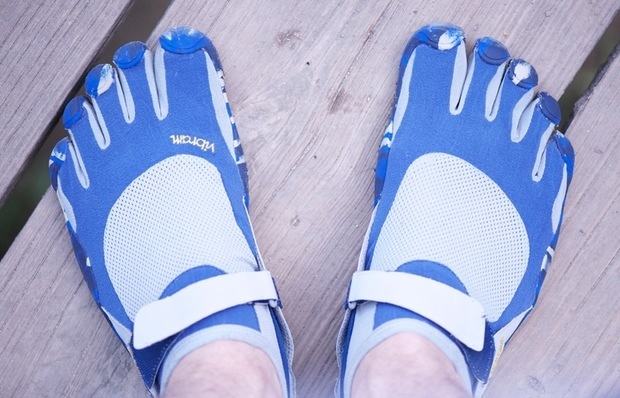
A recent study published ahead of print in Medicine & Science in Sports & Exercise suggests that “Vibram FiveFingers Lead to Greater Risk of Foot Bone Injury”. The problem with this is that the guidelines the authors established did not follow the recommended slow transition they proposed is needed to prevent injury.
To begin with, starting with 1-2 miles is way too much too soon. Regardless of a runners experience if they’re wearing traditional running shoes. Anyone familiar with the 10% rule of increasing exercise amount and intensity would clearly understand this. If you normally run 3-6 miles then its .3-.6 miles for you first 1-2 weeks of running. Not 1-2 miles. So I would expect edema from stress reaction.
Secondly, this line sums it all up.
After the third week of running, subjects were advised to add mileage in the Vibram FiveFingers as they felt comfortable, with the goal of replacing one short run per week in traditional shoes with a short run in the Vibram FiveFingers.
You could be feeling comfortable but injury could be occurring. Remember, overuse is the number one cause of running injuries. Short is subjective. And 3 miles is LONG for someone who has never ran this way before. It should take 6-8 weeks to hit three miles NOT THREE WEEKS.
The runners clearly did not follow the recommendations I gave to Vibram USA who prospered a running brochure 2 years ago. Anyone who has read my text will see this study did not follow the proposed protocol that I have implemented. At the Kent State University College of Podiatric Medicine, we put 12 runners through 6 months of running in FiveFingers and none of them were injured in our recent study with data yet to be revealed. 
The methods these runners followed in my opinion would without a doubt put a runner at risk for injury and would not need any imaging studies to support this.
The other thing to consider is that we don’t frequently MR foot pain unless we suspect stress fractures so this could be adaptive changes. This means that we don’t consider edema normal as we simply have enough asymptomatic changes to compare this to. So basically there could be a lot of individuals with edema that could considered normal but we call a stress fracture.
Further more, anyone who is familiar with Wolff’s Law would understand that bone responds to stress. In order to surmount this stress you need increase blood flow. With increased blood flow you see edema -medullary edema. This study should be titled, “Objective Findings in Runners Offer Further support for Wolff’s Law”.

Below is am excerpt from Dean Karnazes book 50/50: Secrets I Learned Running 50 Marathons in 50 Days — and How You Too Can Achieve Super Endurance!.
As natural as he now seemed gliding along next to me, Governor Huckabee—turned presidential hopeful Mike Huckabee as I write this—hadn’t always been a runner. In fact, he used to be 110 pounds heavier. During his first years in office, simply climbing the steps of the Capitol Building left him out of breath and sweating profusely. He secretly feared that he would be interviewed by the media at the top of the steps, and that he would be unable to respond appropriately due to his lack of breath. In 2003, his physician diagnosed the governor with adult-onset diabetes, informing him that he would not live more than ten years if he did not lose weight.
That was four marathons ago.
Mike Huckabee is living proof of the unique power of running to cure the most insidious health conditions afflicting our society today: obesity, heart disease, and a host of other weight-related maladies, including adult-onset diabetes. But while he may be the most prominent example of what I jokingly call “the amazing miracle marathon diet” at work, there are countless more examples among everyday folks. In fact, as I listened to Governor Huckabee recount his experience—not the least bit out of breath despite the fact that he was running nine-minute miles as he talked—I was reminded that I had already met several Endurance 50 participants, most of them men, who had lost large amounts of weight on the amazing miracle marathon diet.
Below is a great read on how our society is addicted to processed foods.
The article appeared in The New York Times Blog
Behind the Cover Story: Michael Moss on Addictive Foods and What He Eats for Breakfast
Tony Cenicola/The New York Times Michael Moss
Michael Moss, a Pulitzer Prize–winning investigative reporter for The Times, wrote this week’s cover article on the processed-food industry. The article is adapted from his book, “Salt Sugar Fat: How the Food Giants Hooked Us,” which will be published this month.
What first brought your attention to this topic?
I had been writing for the paper about contaminants in food — like salmonella in peanuts and E. coli in hamburger — and the industry scientists I met in the course of reporting said to me, “Michael, as tragic as these E. coli cases are, if you want to see something that makes a lot more people sick, look at the stuff the food giants are adding intentionally to their products.” They were mostly involved in meat production, so they were alarmed by enormous quantities of salt added to processed meats. As I continued reporting, it became clear that salt, fat and sugar together formed the holy grail for the processed-food industry. We all knew that these were in heavy use, but one of the things I was curious about was how the industry was wrestling with the issue. The whole idea was to go inside the industry and see how it was dealing with reports of enormous levels of obesity and diabetes. I was stunned by how many senior officials had over the years become alarmed about the effects of these products. Certainly having thousands of pages of insider documents helped get people to talk, but I was surprised how many were willing to tell the story. What a lot of them had created in the ’80s had meanwhile morphed into something else, something more problematic.
And that change in the food industry carries a whiff of conspiracy in your story.
Well, these are companies after all. Their main purpose is to make money. If they elevate health concerns to the top of their agenda, Wall Street and their competitors are waiting to eat them alive. As I describe in the book, some of the biggest companies did choose to do the right thing by consumer health at various points. But these were unilateral moves, and they were beaten by competitors.
Do you see the only way forward as promoting regulations, or is an agreement among food giants possible?
It’s hard to disagree with the growing number of people who see government regulation as the way to deal with this. And adjusting regulations to give other products, like fruits and vegetables, a more even playing field with products, like corn, that are used in processed foods could be another step. But the $1 trillion a year food industry and its lobby still dominates the Department of Agriculture. Still, I was struck by the former C.E.O. of Philip Morris saying that he’s no friend of government regulation but that what you are seeing in the processed-food industry is that there is no way any one company can make tremendous progress. The industry collectively won’t decide to do it, and at a minimum government regulation would give these industries cover from the huge pressure they have from Wall Street to keep their profits up.
You report that a big concern among food-industry heads was to keep processed food from being compared to cigarettes. But if processed foods became as maligned as cigarettes have, might that be the best thing from a public-health standpoint?
Conceivably. Remember that Philip Morris was the only cigarette company to embrace government regulation as a means of self-preservation. They were worried about losing everything. But at that moment they expanded into noncigarette products. The other grain of salt with the Philip Morris strategy is that it embraced more regulation in this country as it was expanding its market abroad. And in the last decade the processed-food industry is spending more time exporting and marketing these foods abroad, and it is now a problem that the world must deal with. Part of it is the saturation of the American market but also its increasing fears here. But usually the industry has been flexible in its responses to consumer concerns. Sugar was an issue in the ’80s, so you would see low-sugar products; fat was an issue in the ’90s, so you’d see low-fat products. Now salt is more of an issue. But the low-fat products and low-salt products are high in sugar, and the low-sugar products are high in fat. They’ll dial down one ingredient but dial up the others. From the companies’ perspective it is understandable: they want to make as popular a product as possible. But collectively the whole industry is responsible for our heightened collective craving.
Aren’t appetites for salt, sugar and fat natural human cravings?
Every one of our 10,000 taste buds is wired for sugar. But we aren’t born liking salt — we develop a taste for it at about 6 months. There has been some recent science indicating that our liking for salt and our craving is hugely dependent on our exposure to processed foods. Scientists at the Monell Center in Philadelphia, which is partly financed by the food industry, recently did a study where they dumped children into two categories, those who were exposed to processed foods and those who weren’t, starting at 6 months. The first category, by the time they were in preschool, were practically licking the salt shakers. Companies are experimenting with replacing sodium chloride with potassium chloride, because most of the health problems come from sodium. It works for some products, but if you diminish the amount of sodium, people want sugar and fat instead. In Britain, the country as a whole has managed to dial down doses of salt, and that may help address high blood pressure, but obesity continues to rise.
After working on this book, do you live in some pristine otherworld of quinoa and salad?
My family is dependent on processed foods. We have two boys, ages 8 and 13. My wife, Eve, and I both work outside the home. There’s no way with our lifestyle that we can lose all of that dependency. That said, Eve arbitrarily set a limit on the kids of five grams of sugar in cereal — even before I started reporting on the subject. Oatmeal is easy to make, but maybe kids don’t want it. Five grams still leaves choices like basic Cheerios and Total. And it gives them choice and engages them in a discussion. The boys may have to reach low, or I may have to reach high to get the cereal, because Fruit Loops are displayed at eye-level. Eve pulled five grams out of thin air. There is no federal guideline for sugar. It is the one big thing missing from nutrition facts because the F.D.A. has declined to set a number.
Did reporting on this topic change your habits at all?
Yes, to a certain extent. It turns out convenience foods are not all that convenient. Oatmeal, I mentioned, is easy, and making tomato sauce for pasta has about two steps. But as a culture, we have lost the will but also the knowledge to make these. One reason that we eat processed foods is the decline of home economics. Restarting home economics classes is one of the key things we could do to get this issue moving.
What has the response been like to your article so far?
I haven’t had time to go through the thousand-plus comments yet. I’ve been responding to e-mails, from people saying their families are struggling with diet issues and that having the information is empowering for them, but also from company executives. I got calls from doctors saying if you want to see something really deplorable, look at hospital cafeteria food. People from the White House got in touch, to talk to me but also to get in contact with Jeff Dunn, the Coca-Cola former president who is now trying to market baby carrots as junk food. They are interested in his strategies. The response has been enormous.
This post has been revised to reflect the following correction:
Correction: February 25, 2013
An earlier version of this post misstated the given name of the former president of Coca-Cola North America. He is Jeff Dunn, not John.
It’s an awesome feeling to be back marathoning after a few years off!! In order to help runners with their training, and share with others how I train, I’m logging all of my runs in journal format. It’s my hope that other runners can learn from my training principals. I feel it’s more beneficial to understand training yourself, then to follow a black and white printed schedule of how long you should be running.
Below is an entry of the many days I’m logging.
8 mile easy run following an 18 mile run
Its great following a long run with a good distance run. It feels good to loosen up your legs and it also gives you confidence that you have the strength to run 8 miles after a long 18. Basically you did the distance (26.2) miles over two days. Yes, you had time to recover from the 18 miler, but its still 26 miles. From a physiologic standpoint, your body will become stronger from and endurance standpoint by breaking up two long runs this way then by cramming into one. By doing one “longer” run that your body isn’t ready for, all you will end up doing is creating damage to muscle that takes longer to repair (5-7days) which will make your subsequent runs useless, or more importantly damaging. So in the end, if you have logged some long weekly miles, its more beneficial to do say a 16 and a 10 then one long 20. Your long runs should never be 40-50% of your total weekly mileage.

Shoe Name: Skechers GOrun 2
Model: GOrun 2
Weight: 6.6 oz.
Price: $80.00
Drop: 4mm
Website: http://skechersperformance.com/running/all#/53555-gorun2
Forefoot: Very wide forefoot that is just like the GObionic. Plenty of room for toes to move and function as they were designed. Upper is soft and lightweight and doesn’t irritate toes. Feels like a bit more cushion under toes then the GObionic but still remains flexible allowing full bending ability of metatarsophalangeal joints (toe joints).
Cushion: Definitely more cushion then the GObionic and more then I am used to. That being said, I did enjoy it on the 18 mile run I tested them on. The 4mm heel drop is something I haven been used to for several years, but am now choosing to use for long runs (greater then 10-12 miles). The cushion seems well placed and doesn’t encourage a heel strike as Skechers has engineered the shoe to midfoot strike. Basically the construct of the sole allows the shoe to balance on the midfoot. While this doesn’t force you to midfoot strike, it’s carefully placed cushion makes it feel more normal landing on it.
Flexibility: The flexibility has been salvaged despite the increase in cushion. It passes my roll up test. Still able to twist in the frontal plane as well. The foot can still move. Isn’t that wonderful?!!
Overall: I took this shoe out of the box and went 18 miles on it. It felt awesome. I don’t use a cushioned for 80 percent of my runs, but on long runs it helps. This shoe in my opinion is a perfect training shoe for long runs. Remember, for those who follow my philosophy on shoes, training shoes should not provide stability but can provide cushion. These shoes are typically used for longer runs (greater then 10-12 miles). Training shoes can also be a great option for those used to a stability shoe and want to begin transitioning to a minimalist shoe. The GOrun 2 can be a great transiting tool – more so then the GObionic which is a true minimalist shoe.
Once again I find it amazing that Skechers has hit a home run with a running shoe. For the last 20 or so years the shoe manufactures have focused on making shoes hard with “stability” yet promising shock absorbing cushion that barely could be noticed. Finally Skechers has delivered a shoe with cushion yet freedom to allow the foot to move and feel ground. As a purest who believes in barefoot running, I can accept cushion on longer runs as long as you can still feel the ground. This is an important concept known as proprioception – your ability to feel the ground and react to the changes in surfaces your foot encounters through precise muscular control. This shoe provides cushion yet enables proprioception.
Notice how the weight of the shoe rests on the mid foot.

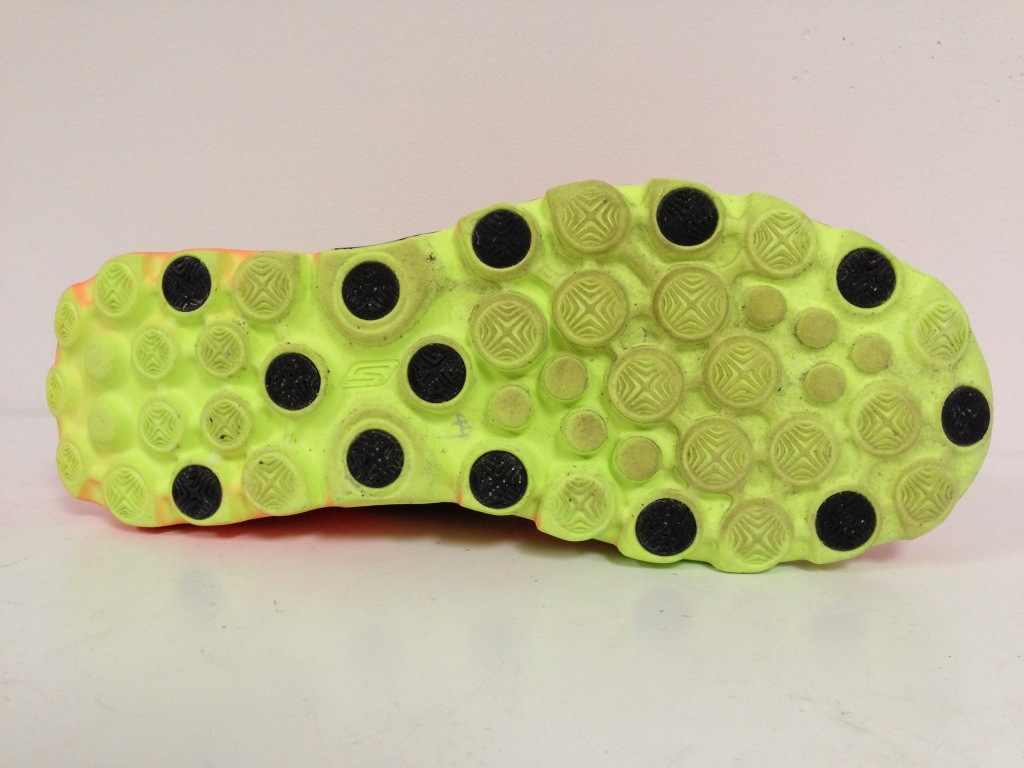


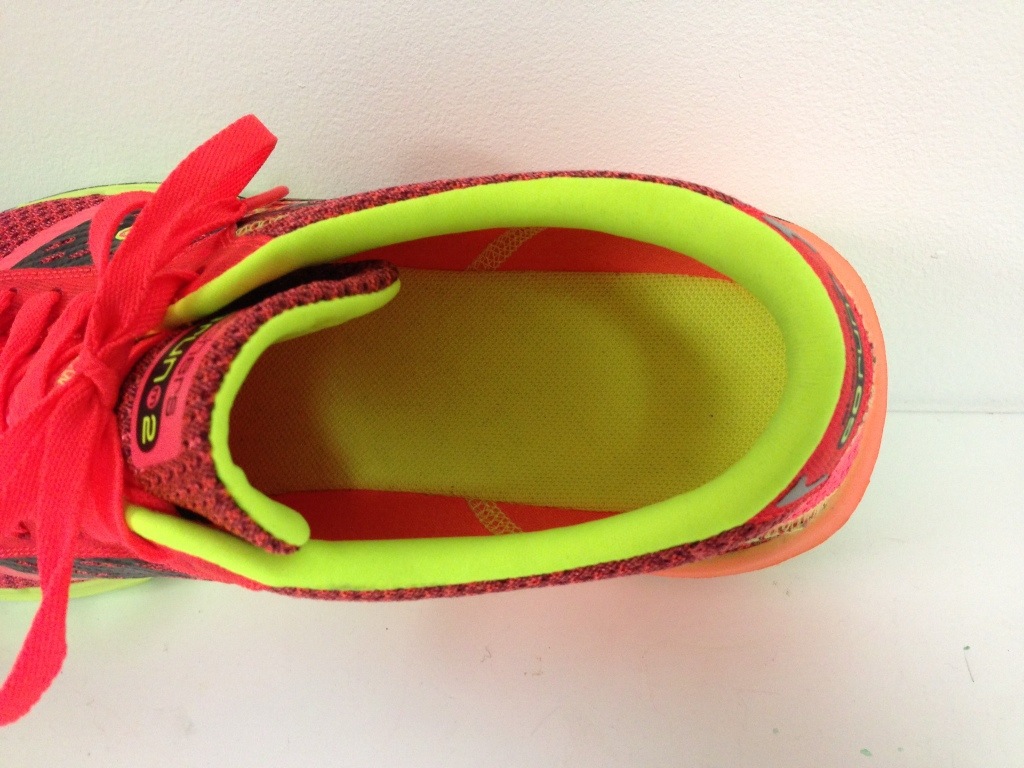


They even come with a 2nd pair of yellow laces!! This doesn’t help you go faster but it is cool!!

Here is a interesting article from the New York Times that discusses when to get rid of your running shoes. When I first started reading it I automatically assumed it was going to discuss the typical recommendations of changing your running shoes every 300-500 miles as described in a 1984 article that has remained the “gold standard”. Even though this mileage criteria has never been scientifically proven, combined with the fact that running shoes have changed drastically since 1984, the 300-500 mile mark is still being recommended as a good indicator for getting new shoes. This article actually gives a good history as to when we can look at changing shoes and what criteria we can look at as opposed to just mileage. I could go on for days about shoes, but here are my two cents before you read the article.
– if you are heel striking, then you probably need to pay attention to the absorptive quality of your shoes. Take home point, stop heel striking.
– race distances can determine which shoe you’ll wear, but not necessarily need, making them last longer.
As for me?
– if i am running low mileage 5-10 miles per run my shoes can last until there are holes in the soles.
– for longer runs 10-20 miles, i do like some cushion but I don’t necessarily need it.
When to Retire a Running Shoe
Ryan Hall, one of the world’s best distance runners, used to pride himself on wearing his running shoes into nubs. No more. Now he assiduously replaces his shoes after running about 200 miles in them. He goes through two pairs a month.
“I know that my shoes could probably handle a couple of hundred more miles before they are worn out, but my health is so important to me that I like to always make sure my equipment is fresh,” he said.
Of course Mr. Hall, sponsored by Asics, does not have to pay for his shoes. Most of the rest of us do, and at around $100 a pair they aren’t cheap. Yet we are warned constantly to replace them often, because running in threadbare shoes may lead to injuries that can take months to heal.
So here’s a simple question: How do you know when your shoes are ready for those discard bins in gyms? And if you do get injured, is it fair to blame your shoes?
My friend Jen Davis runs more than 100 miles a week, like Mr. Hall, but has a different set of criteria for getting rid of shoes. One is that if they smell bad even after she washes them in her washing machine , it’s time for a new pair. She estimates she puts 500 miles on each pair of shoes.
Henry Klugh, a running coach and manager of The Inside Track, a running store in Harrisburg, Penn., says he goes as far as 2,000 miles in some shoes. He often runs on dirt roads, he said, which are easier on shoes than asphalt is and do not compress and beat up the midsole as much.
My coach, Tom Fleming, has his own method. Put one hand in your shoe, and press on the sole with your other hand. If you can feel your fingers pressing through, those shoes are worn out — the cushioning totally compressed or the outer sole worn thin.
As for me, I my practice has been to keep track of the miles I run with each pair and replace them after 300 miles. Who is right? Maybe none of us. According to Rodger Kram, a biomechanics researcher at the University of Colorado, the theory is that you must change shoes before the ethylene vinyl acetate, or E.V.A., that lines most running shoe insoles breaks down.
“Think of a piece of Wonder Bread, kind of fluffy out of the bag,” he said. “But smoosh it down with the heel of your palm, and it is flat with no rebound.”
A moderate amount of cushioning improves running efficiency, he has found. But as to whether cushioning prevents injuries, he said, “I doubt that there are good data.”
Dr. Jacob Schelde, of Odense University Hospital in Denmark, has looked for clinical trials that address the cushioning and injury question — and has found none. He’s applying for funds to do one himself, a 15-month study with 600 runners.
Dr. Schelde did find a study on injury rates among runners, published in 2003, that had some relevant data even though it was not a randomized clinical trial and shoe age was not its main focus. The study was large and regularly tested runners in a 13-week training program. The researchers failed to find any clear relationship between how long running shoes were worn and a runner’s risk of injury.
It also is difficult to find good data on how long E.V.A. insoles last. But one exhaustive study, led by Ewald Max Hennig of the biomechanics laboratory at University of Duisburg-Essen in Germany, involved 18 years of shoe testing from 1991 to 2009. The researchers measured the performance of 156 shoe models worn by runners. Dr. Hennig and his colleagues wrote that the sort of mechanical testing that shoe manufacturers do to evaluate cushioning materials does not reflect what happens when people actually run.
Over the years, running shoe quality steadily improved, the researchers reported. The shoes also changed as running fads waxed and waned. Shock attenuation, for example, diminished starting around 2000, when there was talk of shoes providing too much cushioning.
Then, when cushioning became fashionable again, it returned. But so did minimalist shoes designed for the barefoot running fad, which have almost no cushioning.
In Europe, the researchers reported, people typically wear shoes for about 600 miles. But their studies indicated that shoes could last much longer.
Most shoemakers, of course, would prefer to see us trade in sooner. Kira Harrison, a spokeswoman for Brooks, said shoes should last for 400 to 500 miles. The very light models last about 300 miles, she said.
Biomechanical studies have shown that after those distances the shoes lose their bounce, she said: “Everyone in the industry knows that standard.”
Gavin Thomas, a Nike spokesman, said a shoe’s life span depended on the type of shoe — lightweight or more heavily cushioned — and on the runner’s weight and running style. Those who are light on their feet can wear shoes longer than those who pound the ground. Those who run on soft surfaces can keep their shoes longer.
After 300 or 400 miles, Mr. Thomas said, a typical shoe worn by a typical runner will not feel the way it used to, a sign it is worn out.
But Golden Harper, developer of Altra running shoes and founder of the company, said any advice on mileage was “a lot of malarkey.” Mr. Harper, a distance runner, said most runners could feel when their shoes need to be replaced. “You get a sense for it,” he said. “Nothing hurts, but it is going to soon.”
So when should you retire those faithful running shoes, and what happens if you don’t? Despite the doomsday warnings, no one really knows. And with so many variables — type of shoe, runner’s weight, running surfaces, running style — there may never be a simple answer.
But we can take comfort in Dr. Hennig’s work. Even people like Henry Klugh, who put in many more miles than most guidelines suggest may still be fine. Their shoes may still be performing.
original article posted here:
http://well.blogs.nytimes.com/2013/02/18/when-to-retire-a-running-shoe/
Photos courtesy of Lee Bender @lbender15.

Many runners who get do their “run” out if the way in the morning are rushed to get their day started making it tough to get enough nutrition quickly into their body. Studies demonstrate the most crucial time to refuel after a moderate length run is within 45 minutes to an hour at most.
My advice for any runner is to eat natural foods and stay away from supplemental drinks or shakes. While I have used them (and still occasionally do) I’m much more a fan of recovering quickly with a fruit and veggie smoothie. I make them the night before a run and keep in the refrigerator. As soon as I return from an early morning run its ready and I drink it as I’m preparing to start my day.
There are many sites out there with recipes to create a smoothie, but here are my two favorites that are easy to make.
Green Smoothie:
Ingredients: 2 cups of baby spinach, 1 apple, 1 orange, 1 banana, and squeeze of half a lemon.

Red Smoothie:
Ingredients: 1 apple, 1 orange, 2-3 carrots, 1-2 bananas, 3-4 strawberries (substitute with frozen berries)

A magic bullet can be used to purée the ingredients but if you already have a food processor that is perfect. I use the Kitchen Aid 7 cup food processor.
With the food processor I just place all the ingredients in and let it run for about five minutes. A few ice cubes or water can make it easier to drink by reducing its consistency.
Other options for refueling are obviously available which I listed below but fresh fruit and vegetables allow for a quick intake to keep you until there is time fore a late morning meal or lunch.
Elite runner Lauren Fleshman places a drink in her car and begins refueling immediately. Ideally, take in a drink that contains a 4-to-1 ratio of carbohydrate to protein. Justin Whittaker, D.C., recommends a drink with sodium, calcium, 250 mg of magnesium, 50 mg of zinc, 100 mg of potassium and branch chain amino acids. Read labels carefully, as most recovery drinks don’t provide these vital electrolytes and proteins.
Chocolate milk: The drink you loved as a kid has the ideal amount of carbohydrates and protein that tired muscles need for recovery, says Joel Stager, Ph.D., director of the department of kinesiology at Indiana University. According to a study Stager led, drinking chocolate milk postexercise speeds up recovery and increases the time it takes to reach exhaustion during a subsequent exercise session better than sports drinks. And a 2007 British study found that regular milk is better than water or a sports drink at restoring fluid levels following a bout of exercise in the heat. Plus, milk contains bone-strengthening vitamin D and calcium.
Active.com lists some good ideas for post run fueling. You can read their link below. I however am more of a fan of natural fueling then by using supplements. While they can be ideal for those in a hurry, it’s always best to eat or fuel with natural products – there’s something to be said about that Paleo diet!!






 Dr. Nick's Running Blog