

If it’s good enough for a child, shouldn’t it be good enough for an adult? Then we should be probably be wear less “shoe” on our feet. Below is an abstract that reviews seven points from a article by a pediatric orthopedic surgeon. It is pretty clear that the literature suggests children show be wearing less on their feet or basically going barefoot to allow for proper muscle development and overall foot structure. The same principle applies to the adult. By allowing the foot to function the way it was designed without interfering with or restricting the normal mechanics will allow the foot to become stronger. So does this mean we should run barefoot? The idea is that our foot should be function as though it were barefoot and choosing a shoe that allows this the best should be the goal.
Taken from B. Zipfel, L.R. Berger, Shod versus unshod: The emergence of forefoot pathology in modern humans?, The Foot, Volume 17, Issue 4, December 2007, Pages 205-213, ISSN 0958-2592, 10.1016/j.foot.2007.06.002.
1. Optimum foot development occurs in the barefoot environment.
2. The primary role of shoes is to protect the foot from injury and infection.
3. Stiff and compressive footwear may cause deformity, weakness, and loss of mobility.
4. The term “corrective shoes” is a misnomer.
5. Shock absorption, load distribution, and elevation are valid indications for shoe modifications.
6. Shoe selection for children should be based on the barefoot model.
7. Physicians should avoid and discourage the commercialization and “media”-ization of footwear. Merchandising of the “corrective shoe” is harmful to the child, expensive for the family, and a discredit to the medical profession.
Excerpt from New Book of Running Quotes: “1,001 Pearls of Runners’ Wisdom: Advice and Inspiration for the Open Road”
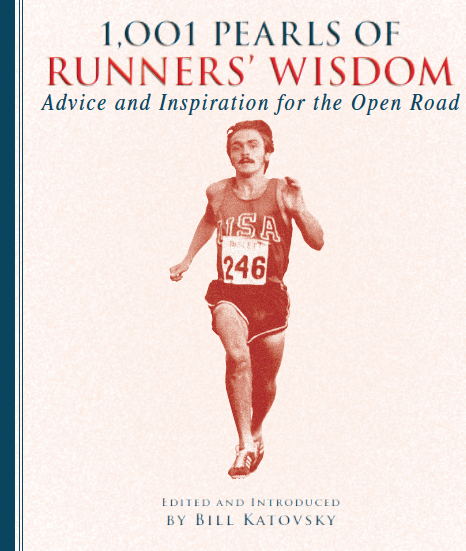
I admit that the past few months have been busy. In addition to co-authoring “Tread Lightly: Form, Footwear, and the Quest for Injury-Free Running” with Pete Larson, I also edited and assembled a new collection of running quotes. And so I am pleased to announce that “1,001 Pearls of Runners’ Wisdom: Advice and Inspiration for the Open Road” has just come out. The “1,001 Pearls of Runners’ Wisdom” covers a wide swath of topics, including training, coaching,marathons, pain, injury, the mile, diet, and natural running. These quotes have been culled from numerous sources: Olympic champions, coaches, running legends, literature, Hollywood, bloggers, and more. There are even chapters on barefoot running, human evolution, and women only. The following excerpt is from the chapter, “There’s No Business Like Shoe Business.” –Bill Katovsky
***
A runner’s two greatest loyalties are not to any shoe company or model, but to the left foot and the right. —Joe Henderson, author and journalist
Sometimes . . . an injury may be due to increased running, fatigue, sickness, etc. and have nothing at all to do with your shoe. —Bill Rodgers
No doubt a brain and some shoes are essential for marathon success, although if it comes down to a choice, pick the shoes. More people finish marathons with no brains than with no shoes. —Don Kardong, author, journalist, coach, fourth-place finisher at the Montreal Olympic marathon
When I was about 14 or 15, and running in a pretty muddy cross country race, one of my shoes stuck in the mud and came off. Boy, was I wild. To think that I had trained hard for this race and didn’t do up my shoelace tightly enough! I really got aggressive with myself, and I found myself starting to pass a lot of runners. As it turned out, I improved somethinglike twenty places in that one race. But I never did get my shoe back. —Rob de Castella, won the 1981 Fukuoka Marathon in a world-record time of 2:08:18
Shoes do no more for the foot than a hat does for the brain. —Dr. Mercer Rang, orthopedic surgeon and researcher in pediatric development
The ideal shoe would provide enough support for a runner during a race, but would fall apart once that runner crossed the finish line. —Bill Bowerman
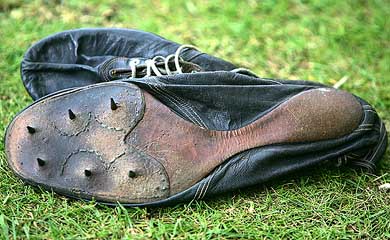
Roger Bannister’s actual track spikes that he wore when he ran the first sub-four-minute mile in 1954.
Your spikes, which were really quite long then, would catch the material of the track and your shoe would get heavier. I was simply filing them down and rubbing some graphite on the spikes. I thought I would run more effectively. —Roger Bannister
Maybe wearing heavy boots in training and light shoes in competition was good; when you change, whoosh. It was very practical. —Emil Zatopek, on wearing Czech army-issue military boots in training
If you want shoes with lots of pep, get Keds. For bounce and zoom in every step, get Keds. —Kedso the Clown, from 1963 Keds television commercial
I would advise that each runner leave shoes and stocking sat home, but of course this should be optional with the individual; next to bare feet are sandals, next to sandals moccasins, next to moccasins, soft, low shoes. —J. William Lloyd, who in 1890 wrote the first treatise on running
Blaming the running injury epidemic on big, bad Nike seems too easy—but that’s okay, because it’s largely their fault. —Christopher McDougall
Motion-controlled shoes and orthotics are like putting a cast on a broken limb. The pain may stop, but the longer you use it, the weaker you get. —Steve Sashen, founder of Invisible Shoes
Each time you try on a pair of shoes, find a hard surface to walk on rather than the thick soft carpet in shoe stores, where almost any shoe will feel good. If there’s no sturdy floor to walk on, ask if you can walk outside (if you’re not allowed, shop elsewhere). —Dr. Phil Maffetone
Abandon the notion that you have a shoe size. Instead you have a foot size. Shoes are made all over the world and apply different shapes and standards. —Dr. Mark Cucuzzella
I see shoes as tools. —Angie Hotz, aka “Barefoot Angie Bee”
For more excerpts, go to RunnerQuotes.com. To buy “1,001 Pearls of Runners Wisdom,” go here. Kindle version is also available.
Foot Pain Secondary to the “Minimalist” Running Shoe Transition
by Dr. Nicholas A Campitelli – Podiatric Medicine and Surgery
As we transition, we are recruiting and utilizing muscles in our feet that we haven’t used in years. These are the intrinsic muscles. The intrinsic muscles perform the functions of flexing and extending toes, abducting and adducting the digits, and stabilizing the joints of the toes or the metatarsophalangeal joints (MPJs.) We discussed calf pain in a previous post that is due to eccentric contractions and delayed onset muscle soreness. The same scenario is occurring with the foot musculature.
Let’s review the muscles to better understand the reason for the location of the pain.
The extensor digitorum / hallucis brevis muscle belly originates on the lateral or side of the foot. The muscle belly commonly swells and enlarges after activity.

 It is Common to experience pain in this muscle belly.
The dorsal and plantar interossei are located between the metatarsal bones and help to stabilize the MPJs as well as splay the toes. It is the hypertrophying of these muscles that leads to the “splaying” we may see after wearing FiveFingers over several months to years.

Pain to the forefoot area that is “pinpoint” over the metatarsal bones, and close to the toe, could represent a stress fracture. Xrays need to be performed if this pain persists.

Pain to the plantar aspect (bottom) of the foot over the metatarsal heads is common secondary to the repetitive pounding but should resolve as you adapt and learn to land softly.
Remember, most muscular pain will worsen upon arising in the am as the muscle is cold, and then will ease up as we move around and “warm up” the muscles. If it does not improve, see your physician for radiographs.
What Can the NBA Learn from Barefoot Running?
May 31, 2012 in by Steve McPherson with 1 Comments

Photo by Nicholas_T on Flickr
When I got my first pair of Nike Shox, I thought this was it: I was finally going to be able to dunk. Now, I was not stupid—or at least not as stupid as I might initially sound. As a 5’10” guy, I knew it would be difficult, but I wasn’t trying to throw down windmills; I was only hoping for what you might call the “Rimgrazer” package in NBA 2K12. This was going to mean lots of work, but some deeply flawed part of my brain—the same part that in fifth grade thought my designs for new Transformers could actually get made—thought that Shox technology was the little boost I would finally need to throw one down. So every other day for at least a month I went to the YMCA and did self-invented drills that would always culminate in a bunch of runs at the hoop.
But I never got higher that touching the bottom of the backboard. I doubt my vertical improved by more than an inch. Then other things came up and I wasn’t making it to the gym regularly for dunk practice. In fact, it was months before I showed up at the YMCA again, only to find out that the lock had been cut off my locker and my basketball and Nike Shox resigned to the lost and found, where they were quickly swiped. It was probably for the best—as The Terminator taught us, technology designed to help can often end up hurting.
For example, in addition to my inability to dunk, I have tremendously fragile ankles, susceptible to rolling and spraining at the slightest touch. As such, the very idea of playing basketball in anything other than high tops was inconceivable to me. I would watch footage of players like Wilt Chamberlain and Bob Cousy playing in Chuck Taylors or other canvas or lightweight shoes and cringe. How could their ankles not be breaking clean off all the time?
But what if they were onto something? The recent rise of barefoot or minimal running as a movement has coincided with an awful lot of ACL and knee injuries in the NBA, and one of the purported benefits of minimal running is decreased stress on the knees. Could basketball players today benefit from going back to simpler shoes and retraining their form?
Jay Dicharry, the Director of the SPEED Performance Clinic and the Motion Analysis Lab Coordinator at the University of Virginia, thinks it’s at least possible (here’s a video with Dicharry going over a self-assessment test for minimal running). “If I ask you to tie your shoes, it’s a simple thing, right?” he says when I reach him by phone. “But what if I coated your hands in marshmallows and asked you to tie your shoes?” Your feet need input stimulation to perform at their best, and when you wrap them in layers of foam and cushioning, your feet don’t get that feedback. Not to mention, he adds, that there is exactly zero peer-reviewed research that shows that high top shoes reduce injuries.
I guess I always sort of knew this, just like I knew some magical springs in the heel were never going to make me jump higher. But high tops made me feel protected, which actually turns out to be part of the problem. “Heavily cushioned shoes let you overstride,” Dicharry says and it’s actually striking to look at the significant knee injuries from this most recent postseason and see how directly overstriding led to them. I’ll spare you the video (which you can find if necessary), but take a look at these stills. Here’s the step that led directly to Baron Davis’ partial tear of his patella tendon and complete tears of the MCL and ACL:

You can clearly see Davis is about to land with his foot way out in front of his body, similarly to how Shumpert landed when he tore his ACL and lateral meniscus:

Shumpert is moving to the side rather than straight ahead, which is also what Derrick Rose was doing just before he tore his ACL:

Now Rose actually suffered his injury on the jump stop directly after this step, but that only points towards how these moves are nothing unusual for these players: these just happened to be the moments when their ligaments let them down. Today’s players are stronger and faster, but they’re also putting more stress on their bodies by changing directions quickly with their weight distributed outside what I would call the “box” of their body. (Imagine a box that extends out from the body the distance of the elbows held out to the side or a leg held out with the knee bent.) For comparison, look at this collection of clips of Oscar Robertson, Bob Cousy, Jerry West, and John Havlicek moving on the court:
You can see that they’re mostly keeping their legs under them. Their knees stay bent, their center of gravity is low. I’m no expert on biomechanics, but Dicharry confirmed my observation, saying that basketball is more a game of being able to change direction quickly, not straight-line speed. Keeping your legs under you is the best way to stay in control of your body.
And staying in control of your body is something that has more to do with how you understand your body in space than what shoes you wear. It’s not as if switching everyone in the NBA to Vibram 5-finger shoes would result in fewer injuries. Dicharry says he’s not even overly concerned about whether a runner has a forefoot or midfoot strike as opposed to a heel strike when he’s looking at their mechanics. Becoming a better runner is about developing a better understanding of one’s body, also known as proprioception.
Blame for this season’s rash of knee injuries was quick to be placed on the shortened season. Kevin Pelton and Mike Pescalooked at ACL injuries over at Basketball Prospectus and concluded that while the shortened season might not be directly to blame, there does seem to be a correlation between fatigue and ACL injuries that may be partly related to a breakdown of proprioception more than physical fatigue.
Pelton and Pesca’s article draws heavily on research by Scott McLean, an assistant professor with the University of Michigan School of Kinesiology. Some of his and his team’s more interest findings include a study that showed “that men and women showed significant changes in lower limb mechanics during unanticipated single leg landings … The research suggests that training the brain to respond to unexpected stimuli, thus sharpening their anticipatory skills when faced with unexpected scenarios, may be more beneficial than performing rote training exercises in a controlled lab setting.”
Whether it involves training athletes to move more conservatively (as Dicharry pointed out in a great turn of phrase, “You can’t fire a cannon from a canoe”) or training them to react more quickly to unexpected stimuli, the bottom line is that the answer lies not with improved equipment but with a better understanding within the athlete of what he or she is capable of. There are, after all, as many people ready to call barefoot or minimal running into question as to herald it. People will always seek the magical solution, whether it be Nike Shox or Reebok Pumps or minimal running shoes, rather than taking the time to learn something through repetition and training.
With teams in the NBA increasingly embracing advanced stats, it should be no surprise when they begin to focus training on neuromuscular education programs designed to help players learn to not only move faster, but smarter. It will take more than just issuing every player a pair of Chucks. After all, the classic Converse sneakers aren’t immune to fantastical breakthrough technical innovations. When Charles Taylor started selling them for Converse in 1921 he incorporated some design improvements. That little badge that bears the star and his name? It’s supposed to provide ankle support.
Dr. Oz: Some daily water intake can come from food
Every year, North Americans each chug down more than 26 gallons of bottled water in a seemingly unquenchable attempt to satisfy our thirst, like Cheryl Ladd’s victims on a recent “NCIS.”

Some of the daily water intake can come from food, including fruits like watermelon. (Herald-Tribune archive)
That amounts to millions of plastic bottles clogging up landfills, and billions of dollars spent on what’s often no more than recycled municipal water. So we have a tip: Eat some of your daily dose of water in fruits and vegetables. You’ll not only quench your thirst, you’ll rev up your disease-fighting powers and make your RealAge younger.
What you do drink can include plain water and juice, nonfat milk, even coffee (the diuretic effect of caffeinated beverages goes away if we drink them regularly, and 1 cup of coffee gives you about 2/3 cup of water). And remember, drink when you want to; don’t wait until you get parched.
But you also can pull down 50 percent of your daily dose of H20 with fruits and vegetables. Broccoli is 92 percent water, a tomato is 94 percent and a pear 84 percent. That means one serving of broccoli (4 ounces) gives you 3 ounces of water!
Get your four to five cups of fruits and vegetables a day, and you’ll take in a third to a half of the recommended intake of fluids. You’ll know you’re getting enough water when your pee is pale (think light beer, maybe).
So set ‘em up, Jack. We’ll take a watermelon shot and a cucumber chaser; hold the ice.
– Drs. Mehmet Oz and Mike Roizen
Below is a great article that appeared in Science-Based Running
http://sciencebasedrunning.com/2011/07/the-basics-cadence/
Posted by Dave on July 5, 2011 | 19 Comments
Kenyan-born Bernard Lagat is one of the most-decorated American middle-distance runners in history, chalking up impressive victories in world championships and holding four American records. He’s also admired by coaches for his fluid running form. While it may not be possible for amateur runners to match Lagat’s graceful stride, there is one aspect of his form that anyone should be able to imitate: His cadence. Take a look at this video from a 5,000-meter race in London:
Lagat moves up four places in the final lap to get the victory, all the while maintaining good running form. But interestingly, although he speeds up dramatically for his final lap (in 51.94 seconds, a 400-meter time some college sprinters would be pleased with), his cadence—the number of steps he takes per minute—doesn’t change.
You can verify this for yourself by timing how long it takes for him to take 60 steps (the easiest way to do this is to count 30 motions of one of his arms). I get 60 steps about every 16.64 seconds, for a cadence of 216. As Jack Daniels observes in his book Daniels’ Running Formula, most elite distance runners share this trait: Their cadence doesn’t vary, whether they’re fresh at the start of a race, or struggling at the finish.
More importantly according to Daniels, most elite runners have a cadence that is much faster than beginning runners; he has rarely observed an elite runner with a cadence slower than about 180. I took a look at a couple more videos and confirmed Daniels’ observation:
Meb Keflezhigi has a cadence of about 203 in this video, and here in the dramatic finish of this year’s Boston Marathon, although Caroline Kilel’s form is suffering as she struggles to hold off Desiree Davila, her cadence is a consistent 180 steps per minute:
Davila’s cadence holds steady, too, at about 194 steps per minute.
Yet beginning and recreational runners typically have a cadence closer to 160, which Daniels says puts them at risk for injury because the longer strides necessitated by a slower cadence take runners higher off the ground. This in turn means that each footfall is harder, and many running injuries are associated with the shock of landing. While Daniels can’t cite a study associating slow cadence with running injuries, I put a lot of weight on his experience coaching thousands of runners.
So how can you improve your cadence? Daniels suggests running “as if you’re on eggshells,” and simply counting your steps as you run to track your progress. For the past week, I’ve been trying it myself in training runs. You can calculate your cadence by timing yourself. Count every step taken by your right foot for 30 steps. Then divide this time into 3600. The first time I tried this, about a week ago, 30 steps with my right foot took me 22 seconds. 3600 ÷ 22 = 163 steps per minute. I’m not much better than a typical beginning runner!
Fortunately you don’t need to do this kind of math in your head while you’re running; all you need to shoot for is 30 steps with your right foot every 20 seconds; this corresponds to a cadence of 180. After a few days, I was able to increase my cadence to 180 quite consistently. For the first couple days, I found it a bit harder than my normal cadence, but after that, I found it wasn’t any more difficult than what I had been doing before. Spot-checking a few times on each of my workouts confirmed that I had successfully elevated my cadence.
What this means for you: Anecdotal evidence suggests that if your cadence is slower than 180 steps per minute, you might be able to reduce your risk of injury associated with landing shock by increasing your cadence.
Update: For a more scientific perspective on cadence and injury, see this post.
The lost secret of running. NY Times November 2011

This New York Times video, The Lost Secret of Running, narrated by Christopher McDougall, author of the popular book Born to Run, demonstrates a cool drill designed to improve your running technique. According to McDougall, The 100 Ups drill dates back to 1874 and teaches runners to be lighter on their feet.
“It’s fool proof, it’s easy and if you learn it you’ll never run wrong again,” says McDougall.
McDougall, a proponent of barefoot (or almost barefoot) running, advocates doing the drill without shoes. Performed as per the video, the drill forces runners to land more midfoot versus heel first, which is the latest trend in running circles. It also narrows your stride, another fix running coaches are pitching to runners of all ages and abilities.
I’m trying to incorporate both techniques and have made considerable strides (pun intended) in the last few months, but there’s still room for improvement. So I’m going to give it a try. Why don’t you do the same and let me know what you think.

Click below to read my article that appeared in Running Insight.
http://digital.turn-page.com/i/65711

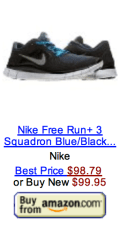
These two studies measured the “pre-study” foot strength and took MRI’s to measure the girth of the foot muscles. Then, they had half the group train in Nike Free’s and a control group train in conventional shoes. By “training” they meant skipping, running, aerobics etc.
In the end (about 6 months), the Nike Free group had increased strength in the foot muscles and increased size of the muscles in the feet. In other words, wearing a less stiff and bulky shoes, the subjects did, in fact strengthen their foot muscles. Based on these two studies (one funded by Nike) we can begin to form the idea that wearing miminalist shoes or going barefoot can strengthen the foot muscles.
Study #1. http://www.staffs.ac.uk/isb-fw/ISBFootwear.Abstracts05/Foot52.Potthast_ChangesInMorphology.pdf
Studied 100 runners and took strength measurements of the feet and toes and MRI’s of their feet and lower legs (to measure the girth of the foot and lower leg muscles). They were divided into two groups and that all had to do weekly exercises including running, skipping and aerobics for 6 months. The difference was that one group was wearing conventional running shoes while the other group wore Nike Free’s. The results? The Nike Free group ended up with significant increase in the toe flexion strength and on the MRI’s, the flexor hallucis longus (the muscle that pushes the big toe down) was significantly larger after the experiment. Some other muscles trended toward an increased girth, but the difference was not statistically significant.
Study #2. http://www.asbweb.org/conferences/2005/pdf/0553.pdf
This study looked at 50 individuals and the study was very similar to Study #1. They took strength measurements and muscle belly girth measurments via MRi and then split the group in two – one group wearing Nike Free’s and the other group conventional running shoes. This study was 5 months long but again, showed statistically significant changes in muscle strength and girth compared to the group wearing conventional shoes.



 Dr. Nick's Running Blog
