
For the past 3 years, my use of orthotics in treating foot conditions, especially plantar fasciitis, has greatly decreased. As a result of being one of the leading advocates of minimalist and barefoot running, I have been able to incorporate this into my practice to help even those who do not run.
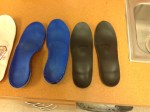
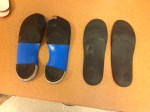
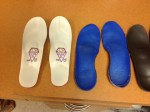
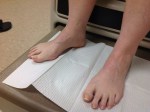
Here is an example of a patient who had continuously been led down the wrong path by being recommended orthotics. She has a high arch, which is not necessarily pathologic or prone to injury, and was told that it needs “supported” with an orthotic. If you have ever examined or felt the foot of someone who has a high arch, it is rigid. In other words it does not collapse upon standing. Why then does it need support? It doesn’t. A high arch is just a variance of foot type. She has dealt with plantar fasciitis for over a year and a half and was treated with 4 pairs of orthotics and numerous shoes all with no relief.
What do I try next? As a surgeon, we used to advocate operative release of the plantar fascia. Studies have demonstrated inflammatory cells are not present within the plantar fascia suggesting that the condition may not be “inflammation” within the plantar fascia. There are 3 muscles that attach to the heel bone in conjunction with the planar fascia. These muscles develop tendonitis when overused or weak by leading to pain upon arising in the morning, and again throughout the day after increased activity. Therefore, treat this like a tendonitis. Splinting may be done but only temporarily. In this case the patient needs to strengthen the musculature and change her gait by not “heel striking” to the degree that most do in shoes with a heel.
We advised her to begin going barefoot everyday for 20 minutes increasing each day as tolerated. When she experiences pain, she needs to activate the flexors to her toes and almost “stand on her toes” to do this. This will build strength. She was educated on proper shoe gear that is minimal and will allow her foot to function naturally without accentuating a heel strike. “Walk as though you are walking across ice” she was told. This is obviously extreme, but it does teach a more correct gait.
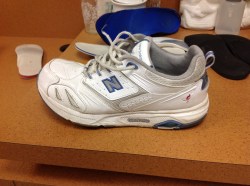
See the gallery of images below revealing the orthotics she was prescribed over the past year and her current shoe gear.

-
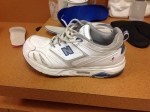
- Motion control shoe that was not alleviating her heel pain.

Below is a post from a Runner’s World Forum. I would like to put into my own words the benefit of this training philosophy and how it works, but here is a short piece to read first. Mine will follow soon!
The idea is to learn how to run the majority of your runs at a truly easy pace based on your heart rate. Phil Maffetone is would class running coach and has proven time and time again that this works with numerous elite athletes. Learn to run at a heart rate of 180 minus your age. For example, a thirty five year old would be running the majority of runs at a 145 BPM pace. Here’s the Post!
A user posted his positive experience using the Maffetone method after a bunch of users who have never tried it criticized the method…
http://www.running-blogs.com/crowther/2009/01/my_least_favorite_endurance_co.html
The common misconceptions about the Maffetone method are:
–it’s about running slow
–it doesn’t include anaerobic training
–there is no room for adjustment, the formula is strict
The first and foremost idea that Maffetone pushes in his books is the maintenance of health. There is a difference between health and fitness. A runner can be fit enough to run a PR marathon, but it doesn’t mean he or she is healthy. My experience on the many running forums on the web, and in my running club, is that there are many runners who are nursing one injury or another, getting sick down the stretch before a goal race, not improving, and hitting the wall and slowing down in marathons. They are running themselves into the ground trying to get better. Maffetone is trying to play his part in changing the no pain, no gain mentality.
His method is not about running slow, but about getting faster and faster at a heart rate where you are using more fat than glycogen as fuel. Running at a low heart rate has less impact, produces little lactic acid, and if the athlete doesn’t overdo it in terms of time on feet, stress hormones like cortisol are greatly reduced. According to Mark Allen, when he first used the 180-age formula, it slowed his training during a four month base period down to 8:00 miles. He was used to training at a near 5:00 pace. ..reference:http://www.markallenonline.com/heartrate.asp
At the end of the period, his time at that heart rate improved by a minute. After a year of mostly aerobic training and very little anaerobic work, he improved his time to 5:20 at the 180-age heart rate (155).
He no longer felt unhealthy.
My own experience is similar. Improving at this heart rate improves race times across the board. I knocked twenty three minutes off my marathon time, and 8 minutes off my half marathon time. My 5k times also improved. Best of all, all minor injuries disappeared. I was no longer cranky, and never felt overtrained or sick.
Maffetone’s method is not so much centered around the 180 formula as it is what he calls the Maximal Aerobic Function test, or MAF test. This is a 3-5 mile test performed at the calculated heart of 180-age, plus or minus any adjustments. It must be said that Maffetone’s definiton of aerobic is processing oxygen using predominantly fat (a function of the slow-twitch fibers). The purpose of the MAF test is to monitor aerobic progress. If your tests are getting faster, then that usually means what you are doing is beneficial to the aerobic system. If they are getting worse or on an abnormal plateau, that usually means that something is impeding your aerobic system. He writes about how some of his athletes have had a period of unusual stress from family or work, and there MAF tests start regressing. Often he would prescribe less time on the feet, and the tests would start improving again. Life and running stresses all add up. On a personal basis, I have found the tests to be an invaluable tool of keeping tabs on the system. My MAF tests always regress by the end of a racing season. I have also seen regression during highly stressful times in my life. When I reduced my running load, they’d improve again.
Maffetone does not exclude anaerobic training from his method. He does say that in his experience that not very much is needed, and that he found no difference in anaerobic improvement from someone running intervals at 90% MHR or someone running at 95% MHR. He would suggest just doing intervals at 90% since they are less of an impact. If you choose to do them any harder, then keep track of the MAF test. He also found that 4-8 weeks was enough, depending on the athlete, any more and the MAF tests would start to regress. The MAF test is the key to the program.
Again, all these things tie into the idea that an athlete should be healthy before being fit.
He talks about adjustments to the formula. If someone with a low MHR is not improving at the 180-age, then the number should be lowered. He also has adjustments for having been injured, people on medication, etc.
One of the most important changes I made to my training on Maffetone’s suggestion is running by duration and not distance. Before I came to the method, I was putting in 60-90 miles per week through the year. This added up to 12-14 hours on my feet. I reduced my schedule to two 90-minute runs and one 2 to 2.5 hour, with 45 minute recovery runs on the days in between. My mileage went down to 40-60 miles and 6-8.5 hours per week. I believe that two hours on your feet is two hours on your feet no matter who you are. An elite might be able to get twenty two miles in that time at an easy pace, and I can only get thirteen, but it is the same impact. My marathon time improved not doing any run over 16 miles. That’s all I could get in in two and a half hours at my peak.
Mark Allen used the method in a rebuilding year, and then for base training on a yearly basis. He also did speed training, but not during the base period.
My experience thus far is that it works just as he says. I have experienced greater health. I spend less time running. I have not experienced a wall in a marathon in three years, and my times keep improving. Less than before, but still improving.
the first year was tough, as running so slow at first sucked, but it paid off. I got much faster as promised.
It’s not a perfect system, as I know perfection doesn’t exist. Most of it is based on Maffetone’s experience rather than scientific studies. It might not be for everyone, but I believe health is for everyone, and this is one way to stay healthy and improve at the same time. If you find that you are always coming down with an injury, hitting the wall, or feeling tired most of the time. I suggest you give it

In efforts to resolve those butterflies in everyone’s stomach, here are some tips to consider for your upcoming race.
The first mile.
It’s common to hear others say, “Run your first mile SUPER slow!!!”, or if you are aiming for a 9:00 pace, run the first mile at 10:00 mile. The result of this will be just that- a super slow mile or the loss of one minute that you will have to then make up. The message that they should be relaying is do not KILL it for your first mile. By running too fast you can burn that stored glycogen too soon, but by no means is slowing down a full minute the right thing to do. Go out at your desired race pace with the aim not to run faster.
I’m going to “pick it up” the last 6 miles.
Most of those who trained for the full marathon probably did a 20 miler as their long run. With the thought of getting a PR or beating a specific time some think that they will try to run harder the last several miles. Realistically, even if you ran a minute faster each mile (which is very difficult at this stage of the race) you will only improve by six minutes. It would be more efficient from a glycogen and oxygen standpoint to run 10 seconds per mile faster the entire race and then “picking it up” as best you can the last 3 miles.
For those who have trained for the half, this is a different situation and does not hold true. Running faster the last six in this case would tie in with a “negative split.”
Why a negative split and what exactly is this?
A negative split means to run the last half of your race faster then the first half. There are multiple reasons why this is beneficial, but her is a simple explaination. Your body has only so much energy to run a race. When we perform at distances of 13.1 miles or greater, we need to conserve this energy and use it very wisely. Let’s use the analogy of currency. If you have $100 to spend to get you through the entire race, and you know that each half will cost you $50, then spending $75 for the first have will leave you with only $25 to finish. In other words, if you too much energy early on, you will deplete your glycogen stores and run out for the second half of the race. The challenge is to know your body’s limit and conserve for the first half, then spend more for the second half. Given your body’s fitness level, it would be physiologically impossible to run the first have faster then the second half and end with the same time. Meaning if you would burn out the second half and run slower. So either try to pace yourself evenly the whole race, or hold back just a bit for the second half.
What can I do to run faster on race day?
Nothing. Remember, you spent the last 3-6 months building your engine for race day. You can “mentally” run faster, but only to a given extent of what your body can allow. Meaning your level of fitness and ability to utilize glycogen and oxygen has already been established. Enjoy the race and run to your body’s own potential regardless of what the person next to you is doing.
The Day Before.
More like the week before. While carb loading has never been scientifically proven to have a definite benefit the night before, here’s some of the reasons it has caught on. We know we need glycogen stores to run long and we can gain this from eating carbs or pasta. The problem is that over loading on this the night before a race doesn’t build the stores as adequately as one would think. There may be more benefit to gradually increasing the week before. It’s also discussed that carbs are easier to digest the night before and this is needed to not have a full stomach. Again, what ever is easier for you to eat the night before makes more sense. If you over do it with pizza and pasta, you’ll be on the throne all morning. Not fun. Eat a “normal” portion. Getting some carbs the AM before the race would have more benefit.
Fluids the Day Before.
Again, the week before. In fact, YOUR WHOLE LIFE! Our body’s function better well hydrated. We don’t “normalize” ourselves by drinking a ton of fluids in one day. To hydrate sufficiently means to consume the adequate amounts of fluids on a daily basis and activities, environment, sweating, salt intake, etc., can all change the requirements. Our electrolytes can’t be “finely tuned” overnight.
Dunkin’ Donuts the morning of race?
I won’t even answer that. Eat light, but something to get some glycogen accessible for your body: a bagel, toast, OJ and an energy gel. If you want that cup of coffee that’s okay. Your body likes routine and if it’s used to the caffeine in the morning then that’s fine. Just don’ t drink too much because you risk the “jitters” from the caffeine as well has over hydrating. I know what you’re thinking, “How can coffee with caffeine over hydrate me, it’s a diuretic?” Well, it’s been described as being a diuretic but you see it now in energy gels. The jury is still out. What tends to happen though is you will have that cup of coffee and then follow it with water to hydrate and end up drinking too much resulting in an increased need to urinate.
Mile Times Wristband.
Even though you may be wearing a Garmin, it’s helpful to remember what your time should be at each mile for your goal pace. This website offers an easy way to create a wristband that can be printed out and worn the day of the race. Very beneficial.
http://www.marathonguide.com/fitnesscalcs/PaceBandCreator.cfm
When Should I use my energy gel?
It’s hard to say exactly when everyone will need more glycogen. It will all depend on your fitness level and efficiency and pace. Many of the elite marathoners do not even use the energy supplements because they are so well trained and efficient that it is not needed. If you trained with supplements, then follow the times of when you took them on your long runs. For example if you are used to taking one at the one hour mark, then take one. On race day, they are beneficial because it never hurts to have more glycogen at hand. During training however, it’s best to try to avoid them to make yourself more efficient at tapping into your own stores. Definitely do not wait until you feel weak or tired. Then it’s too late.
Keep warm at the start.
Static stretching (bending over and touching toes and HOLDING) before a race has no real proven benefit unless you are injured. Warming up by bouncing around, hopping, or even dancing can be of more benefit. Why do you think kids skip and bounce around so much? Because it feels good and loosens up the facia (deep tissue connecting muscles) to prepare for activity. It also helps to wear an old shirt etc, to keep warm and then throw off as you begin your run. Typically these are collected and donated. Furthermore you clean out your closet!
Have Fun.
Our bodies were made to run. For some it may be a race, but at then end of the day, this should be fun!
-Dr. Nick

It’s not too often that I can blog about a new product from Apple, but I couldn’t pass up this opportunity. When the new iPhone 5 arrived on my doorstep, I didn’t realize I would be more awestruck by the new headphones dubbed as “EarPods” then the iPhone itself. I have pretty much ran with every possible headset available and I have to say these by far top all of them I have ever put into my ear.
To start with, they are extremely comfortable and fit firmly in your in ear without creating a seal that makes you feel like you are under water. The sound is emitted from the end of the ear pod and directs it toward the eardrum creating a cleaner sound while allowing for a tighter fit. The bass that is delivered is also richer and deeper due to a new technology that allows for air to pass through the stem of the pod, acting as an acoustic chamber, and then flow out.
Apple sound engineers — acousticians — were focused on improving sound quality. They established a target sound for the Apple EarPods. That target: a person sitting in a room listening to high-quality speakers.The overall audio quality of Apple EarPods is so impressive, they rival high-end headphones that cost hundreds of dollars more.
I’m sure many will argue that they have a wire and are not Bluetooth, but here’s something to consider. The iPod shuffle is an inexpensive running MP3 player that offers more then ample storage and costs only 49.99 making it basically disposable. When you compare the cost of a case for your iPhone to run with, as well as the price of a Bluetooth headset, you are well over 49.99 and then you have to worry abut breaking a minimum 649$ device. Not fun to be caught in the rain on a 10 mile run with your iPhone that may not have been protected from rain in your armband. Not to mention its heavier.
Bottom line, the $29.99 is well worth the price even if they become a disposable headset as a result of sweat etc. The design did take into account improved resistance to sweat. We shall see!!
I welcome everyone’s comments!!
Originally appeared in:
http://www.podiatrytoday.com/blogged/sharing-insights-minimalist-shoes-worn-athletes-recent-olympics
Even a month after the end of the Olympics, I still get questions about the bright yellow shoes I am wearing. People often ask if they are the same kind of shoes from the Olympics this year. My shoes are actually New Balance Minimus sneakers and those that many of the Olympians wore are from the Nike Volt collection.

The Volt series has a total of 16 different shoes categorized by Nike as sprints, distance, field and marathon shoes. The first three categories are for the track and field events, and are spiked. The marathon collection has three shoes designed for distance running: the Flyknit Trainer, the Flyknit Racer and the LunarSpider R3.
Although many refer to these as minimalist shoes, purist minimalist runners may not agree. The shoes still have a significant heel to toe drop.
The Flyknit Trainer has an 11-mm drop and the Flyknit Racer has a 10-mm drop, both of which would be considered closer to a traditional running shoe. The LunarSpider R3 has the lowest drop at 4 mm, making it the closest to a minimalist shoe. However, many have complained that the forefoot is too narrow, unlike the wider toe boxes in shoes like the New Balance Minimus series.
Mo Farah and Galen Rupp, who finished first and second respectively in the 10 k at the 2012 Olympics, were wearing the Nike Zoom Mamba 2 from the distance collection. This shoe basically offers a long distance track spike that has no heel height and a very minimal cushion. You can see still images of Rupp’s form as he demonstrates a forefoot strike pattern throughout all 6.2 miles of his race (see http://biomechanics.byu.edu/footstrikes10krupp.jpg ).
Currently, the Nike Free shoe, although not a member of the Volt collection, is the number one-selling minimalist shoe today. While some still argue it is not truly a minimalist shoe, it has no midfoot support and full sole flexibility to promote a more natural gait.
Watch a group of elite runners warming up and you won’t see any of them bending over trying to reach their toes. Instead, you’ll see athletes moving their bodies to improve their range of motion, increase flexibility, and guard against injury. “Stretching has progressed to a more functional, dynamic method.”
Is this the right way to go? The literature is now supporting dynamic stretching as opposed to static stretching. Various studies have demonstrated that static stretching (slow stretch by holding an isolated muscle in a stretched position) offers no improvement in performance or reduction of injury. We are now finding that dynamic or bouncing activities can be more beneficial in warming up the musculature to improve running efficiency as well as reduce injury. Most medical professionals are now only advocating static stretching for patients who have an injury in efforts to gradually control the amount of stress on the muscle.
Below you can watch track star Michelle Jenneke show off her dance moves as she warms up for a 1st place finish in the 100M hurdles. Michelle Jenneke dancing for warm-up

So maybe there is motivation behind learning the new moves from PSY’s viral you tube sensation hit Gangnam Style!!
Click to watch PSY’s Gangnan Style video
References:
Aguilar AJ, DiStefano LJ, Brown CN, Herman DC, Guskiewicz KM, Padua DA. A dynamic warm-up model increases quadriceps strength and hamstring flexibility. J Strength Cond Res. 2012 Apr;26(4):1130-41.
Carvalho FL, Carvalho MC, Simão R, Gomes TM, Costa PB, Neto LB, Carvalho RL, Dantas EH. Acute Effects of a Warm-Up Including Active, Passive, and Dynamic Stretching on Vertical Jump Performance. J Strength Cond Res. 2012 Sep;26(9):2447-2452.
Turki O, Chaouachi A, Behm DG, Chtara H, Chtara M, Bishop D, Chamari K, Amri M. The effect of warm-ups incorporating different volumes of dynamic stretching on 10- and 20-m sprint performance in highly trained male athletes. J Strength Cond Res. 2012 Jan;26(1):63-72.

What used to be “standard” is no longer.
Excerpt from the book, Tread Lightly by Pete Larson and Bill Katovsky. Here they discuss a very interesting point that I have been referring to – we have no evidence that traditional running shoes prevent, reduce, or cure injuries to runners.
In 2011, a remarkable paper titled “The effect of three different levels of footwear stability on pain outcomes in women runners: a ran-domised control trial” was published by Michael Ryan (then at the University of British Columbia) and colleagues in the British Journal of Sports Medicine. One of the coauthors of this study, Gordon Val-iant, works for the Nike Sports Research Laboratory, and Nike provided footwear and funding for the study. Keep this in mind as we go through the results—the study was supported by Nike, the biggest sports shoe manufacturer in the world, and they allowed it to be published. In their introduction the authors state the following surprising detail: “. . . de-spite over twenty years of stability elements being incorporated in run-ning footwear there is, as yet, no established clinically based evidence for their provision.” Shocking, isn’t it—despite twenty plus years of use, we have no data showing that pronation control elements in shoes are accomplishing anything of value for runners in relation to injury pre-vention. The study then goes on to point out that “Motion control run-ning footwear has yet to be proven to prevent running-related injuries.” Huh? Aren’t these the shoes assigned to those who have the greatest risk of succumbing to an injury caused by excessive pronation? But there is no evidence or proof that they actually work to prevent those injuries? So the big question is why has the athletic footwear industry been so long wedded to a shoe-design and fitting model that has never been proven to actually work? Given the lack of data on efficacy of pronation-control devices in running shoes for injury prevention in runners, Ryan and his colleagues decided to put the paradigm to the test. They designed a study whose goal was to determine how female runners assigned to the three categories of footwear based on their foot posture index would fare in terms of pain and injury experienced while training for a half marathon (note: foot pos-ture index is an indirect way of determining pronation through various measures taken from the foot and ankle). A total of one hundred and five women were classified as either neu-tral (fifty-one women), pronated (thirty-six women), or highly pronated (eighteen women). Now here’s the really interesting part. In a shoe store, the neutral women would be assigned a neutral shoe, the pronated wom-en a stability shoe, and the highly pronated women a motion control shoe—got it? In the study, however, the researchers took each of the three groups of women (neutral, pronated, and highly pronated), and broke them into sub-groups so that one-third would get a neutral shoe (Nike Pegasus), one third would get a stability shoe (Nike Structure Triax), and the final third would get a motion contro shoe (Nike Nucleus). This was done for each of the pronation groupings, so that there would be some women in each pronation category wearing each type of shoe (i.e., many of them wearing the “incorrect” shoe for their foot). The women in the study were then sent off to take part in a thirteen-week training program to prepare for a half-marathon to be run in Van-couver, British Columbia. Estimated weekly training volumes started around twenty kilometers and rose to a peak of about forty to forty-five kilometers. Over the course of the training program, the researchers re-corded the number of missed workouts due to injury by each runner, and collected reports of pain at rest, during daily living, and following runs. Ultimately, only eighty-one of the women wound up completing the study (for a variety of reasons, twenty-four women dropped out). The results showed the following:
1. 32 percent of the women missed training days due to pain over the course of the study. Another way to think of this is that there was an injury incidence of 32 percent in this population of runners, which is in line with other studies on running injuries. 2. Motion control shoes “resulted in both a greater number of injured runners and missed training days than the other two shoe categories.” In other words, motion control shoes faired very poorly all-around. 3. Every runner in the highly pronated group who wore a motion control shoe reported an injury. In other words, all runners (yes, all of them . . . 100 percent!) who were supposed to be wearing a motion control shoe based on their degree of pronation got injured. The sample was small, but this is simply astonishing. In fact, highly pronated runners actually fared better in neutral shoes! 4. Neutral runners experienced greater pain during or after runs when wearing neutral shoes than they did when wearing stability shoes. Al-though the authors point out that the difference may not be clinically significant, it is once again amazing that neutral runners fared better with a shoe that would not have been “prescribed” for them in a shoe store based on their degree of pronation. 5. Pronated runners experienced more pain during or after runs if wear-ing a stability shoe than if wearing a neutral shoe. Again, they did better wearing the “wrong” shoe for their feet.
So what can we conclude from these findings? Motion-control shoes offered little benefit to the runners in the study, and in fact were more likely to cause pain and injury than any of the other shoe types. The fact that every single severe overpronator experienced an injury in her motion control shoes demands further investigation. In the absence of other evi-dence, why should anybody wear them for preventing a running injury? The authors themselves conclude, “This study is unable to provide sup-port for the convention that highly pronated runners should wear motion control shoes.”
Second, this study showed that neutral runners did better in stabil-ity shoes, and pronated runners did better in neutral shoes. Try to make sense of that finding! This is a complete reversal of what would be expect-ed based on the current pronation-control model. This rather startling result calls into question the manufacturer practice of classifying shoes based on degree of pronation control, and it also raises serious questions about the fitting process employed by many shoe stores—should they re-ally be placing runners in shoes based on their degree of pronation? Ryan’s study offered this rather frank assessment of the status quo: “Current conventions for assigning stability categories for women’s run-ning shoes do not appear appropriate based on the risk of experiencing pain when training for a half marathon. The findings of this study sug-gest that our current approach of prescribing in-shoe pronation control systems on the basis of foot type is overly simplistic and potentially injuri-ous.” This doesn’t instill much confidence in the current system, does it? By allowing publication of a study that openly states that there is no clinical data showing that shoes designed to control pronation do anything to prevent injuries, Nike took a great risk. It’s comparable to a pharmaceutical company selling a drug for over twenty years that has never been shown clinically to be of any benefit to a patient who suppos-edly needs it. It makes one wonder if the whole pronation-control shoe paradigm is nothing more than a giant marketing gimmick whose goal is to scare consumers into buying shoes based on fear of injury. It’s a time-honored marketing tactic—convince consumers of a need, and provide a product that supposedly fulfills it. In this case, the need is a neutral gait in order to reduce injury risk, and the products are the shoes that promise to correct gait to meet the need. Furthermore, in the absence of evidence showing that running shoes either do or don’t reduce injury risk (or maybe even increase it), why stop making something that continues to sell and has come to be expected by consumers?

Taken from the book Tread Lightly by Pete Larson and Bill Katovsky.
http://www.treadlightlybook.com/
Dr. Mark Cucuzzella is a family physician and the owner of the nation’s first minimalist shoe store, Two Rivers Treads, in Shepherdstown, West Virginia, which opened in the spring of 2010. A top masters runner, who at the age of forty-four won the 2011 Air Force Marathon outright, Mark is also the ex-ecutive director and co-founder of the Natural Running Center. He shares his experience, insight, and wisdom about pronation, proper fit, and how to find a “running shoe” that best works for you.
When customers enter our store, questions always arise about pronation. Many of them have been labeled in the past as pronators by well-meaning employees at other running stores. Some claim that they have been classified as supinators. All they really want is shoes that fit, and that will help them to run injury-free. Yet the process of determining which shoe will best meet their needs is not something so simple as watching them walk or jog ten steps across the store floor. This kind of evaluation certainly won’t help the runner find the right shoe. So the first thing we do with these customers is have a conversation. We explain what pronation is. Then, we discuss the shoe-fitting process. We don’t rush through this either. Every runner is unique. Some will need shoes with greater or lesser support and mobility control, depending on his or her foot strength. Pronation is a normal function in the gait cycle, just like bending the knee or extending the hip. Pronation control can be achieved with your foot (ideal-ly), with a shoe/insert (maybe), or both. Maximum pronation actually occurs when your heel is off the ground, so the foot’s role in this process is critical. Let’s start with the foot itself, a remarkable engineering feat as de-scribed by Leonardo DaVinci: twenty-eight bones, multiple arches, and accompanying muscles and ligaments that move dynamically to balance, stabilize, and propel one forward. Children running barefoot naturally feel the ground and their muscles work reflexively to provide pronation con-trol. Runners (with or without shoes) who have strong feet have the abil-ity to control this motion just fine. The foot works best when it receives sensory information on where it’s landing, and a firm surface is best for feedback. Overly soft shoes delay the feedback. Remember that a runner’s foot is on the ground for only a few fractions of a second, so the pronation control must be immediate and strong.
Spending a lifetime in stiff, overly cushioned, and supportive shoes has diminished natural pronation control for most modern-day runners. The shoe has done some or all of the work for them. To see for yourself, try bal-ancing on the ball of one foot. Can you hold the position for a second? Ten seconds? Thirty seconds? Can you pop off the ground with springy recoil while jumping rope? If you are having difficulty, then you may need to take certain measures if you want to transition to more natural pronation control and run in a true minimalist shoe. Why is natural pronation control better? The foot is the magic spring that adds elastic recoil to our stride. This is free energy. When the foot is constricted by being made to “move” within a rigid shoe, it cannot work well as a spring and you need to apply more muscle force to the stride. More muscle use results in greater fatigue and less efficient running. My recommendation to all runners is to make a gradual transition if you want to strengthen your feet. Do plenty of walking barefoot and in minimalist shoes. Start your transition to running slowly and remember that your muscles, tendons, ligaments, and bones are adapting and do not have the capacity for the added load yet. Do supplemental foot strengthen-ing throughout the day. Stand on one foot, balance on the ball, walk bare-foot in the house and outdoors when you can. This can only help your run-ning. You may have a little soreness like with any new training. Tissues are lengthening and strengthening. Extreme soreness means you are progressing too quickly and asking the tissues to do too much too soon.
Proper Fit Explained
Two years before I opened Two Rivers Treads, I had completely rethought how a shoe should fit. It involves much more than just picking a size and sticking with it. Sizes and fit vary from shoe to shoe, and our feet can change size and shape over time. For example, I have started running many more true barefoot miles over the last year and my foot has greatly increased in thickness—I now need to consider this change when choosing a shoe. At our store, we defy old-school thinking about sizing and narrow-shaped, ill-fitting conventional shoes. Improper shoe sizing and shape are the primary cause of ingrown toenails, bunions, corns, hammer toes, and hallux valgus. Shoes that don’t fit your feet correctly can also lead to muscu-lar imbalances in the body, leading to foot, knee, and hip injuries. A proper fit accommodates the natural expansion of the foot upon ground contact. Excess waste is eliminated, along with everything that inhibits your foot’s natural motion. Your foot is free to move and work the way nature intended it to; the way of its own barefoot motion. Call it toe-wiggle freedom. We educate on how to safely and gradually make this transition. Yet, with sizing, most get it wrong. First, abandon the notion that you have a shoe size. Instead you have a foot size. Shoes are made all over the world and apply different shapes and standards. If you measure your foot while seated with a traditional measuring tool like a Brannock device and base your size on that you will likely be off by one to two sizes in a running or hiking shoe. Increasing one full shoe size is equivalent to adding only 1⁄3
an inch to the length of the shoe. Also critically important is that the Bran-nock device measures the widest part of the shoe at the ball. Infants and habitually barefoot individuals have feet that are widest at the ends of the toes, not the ball of the foot—this is the natural alignment of the human foot, and shoes should respect this. Here’s why many people are wearing shoes that are too small: • When a load is applied to a foot by running or with a pack weight your foot will spread in length by up to half an inch.
• You need at least 1⁄8 inch or more of space in the heel and toe to allow space for a sock.
• You want 1⁄3 to 1⁄2 an inch of space in front of your big toe to allow room for loading and splay.
• Your foot will increase in width by 15 percent due to splay under load.
• Your foot is widest at the toes, and unfortunately most shoes are not shaped this way.
tips on sizing:
• Do not assume that you are the same size in every shoe.
• Take your time and try several shoes on. Go run in them. Do not try them on while sitting.
• Always try both shoes on. If your feet are slightly different in size then fit the larger foot.
• Take the removable insole out of the shoe and see how your foot fits against the insole as a template. Is there room at the toes or does you foot spill over the insole? If there is no room to spare or if your foot spills over this shoe will not fit comfortably.
• Keep going one half-size up until the shoes are obviously too big.
• Try on shoes at the end of the day when feet are most flattened and swollen.
• Try shoes on with the type of sock you will wear for activity.
• For women, you may fit better in a men’s shoe for width.
• Do not lace the shoes up tight. Allow spread in the midfoot and forefoot.
• Go up onto the ball of the foot. Can you put your index finger between your heel and the back of the shoe? If not, the shoe is likely too small.
• Consider not using the soft insole. This takes up space in the shoe and can interfere with ground feel.
• Walk on a firm surface when trying shoes on, not a carpeted one.
• If you are a runner you must run in the shoe. What feels nice and soft when walking is the opposite of what you need when running. Look for firmer base to allow for better sensory input and to facilitate stabilization.
Children’s Shoes:
What children wear growing up has a strong influence on foot structure and function when they are adults. Given this, selection of healthy footwear for children is critical. You should select proper shoes for your children based on the following:
• Ultra-thin soles to allow adequate sensory perception, proper neuromus-cular activation in the entire kinetic chain, and to complement the body’s natural ability to absorb ground reaction forces. • Low, flat to the ground profile—shoes should not have a slope from heel to forefoot.
• The materials should be soft and supple, thereby allowing natural foot function. The shoe should bend easily at the toe joints—this is where a foot is designed to bend to lock the arch on takeoff.
• The toebox should be wide enough to allow natural toe spread. Foot sup-port is created by the natural arch of the foot with the great toe helping to stabilize the arch. When the great toe is pushed in toward the second toe (a common design flaw in many shoes which come to a tapered point), this stability is compromised. The foot produces the most leverage when the toes are straight and aligned with the metatarsals. A child’s foot is widest at the ends of the toes (as should an adult’s be if they have been in proper shoes or barefoot).
• A single piece midsole/outsole allowing protection on unnatural surfaces (concrete, asphalt) and natural rough surfaces (rock, trail) while allowing sensory perception and natural dissipation of ground reaction forces.
• Upper material should be soft, breathable, and washable.
• Discourage the use of thick, heavy socks as these can constrict the foot and interfere with sensory perception.
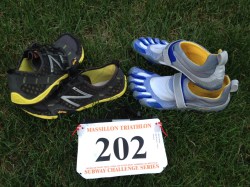

Lee Trains in the Bikila FiveFingers and races in the NB Minimus Trail shoes.
As more runners are hearing about minimalist shoes, they are finding that they were actually running incorrectly in their traditional running shoes. Here is yet another example of how someone figured out on their own that the “shoes” weren’t helping his running. In fact, they were actually hindering it.
Lee’s Story
I started running weekly about 5 years ago in Asics Gel Kayano’s. For 2 years, I couldn’t run more than 2 miles without having to ice down my knees & ankles after every run. My Iliotibial band was also giving me pain on the outside of both knees & hips. I visited Second Sole and they recommended that I switch to the Mizuno Wave Riders. These shoes helped at first, allowing me to run a little further, and while they slightly reduced my knee & ankle pain, by the end of the summer, the same intense pains were back. Then, 2 years ago in combination with my diet, I switched to the New Balance Trail Minimus shoes, which completely eliminated all knee, ankle and IT band pains. I am now able to run further, faster and pain free! For the last several months, I’ve been running primarily in the FiveFingers (Bikilas)—still use the NB Minimus for my triathlon races.
Not only has Lee resolved his pain, he stay’s ahead of the other runners. In this most recent sprint triathlon Lee finished second to the winner who qualified for the Ironman World ChampionshipSaturday, October 13, 2012 in Kailua-Kona, Hawaii.

Lee is leading at this point of the race (Bib 202)
Click to read local news article http://m.indeonline.com/indepen/db_98381/contentdetail.htm?contentguid=LJXUzoMK
Obviously there is more to it then the “shoe”, but it is more anecdotal evidence that the shoe doesn’t make as much of a difference as we all once thought it did.
Lee’s Race Results:
4-Mile Run: 5:54, 5:58, 6:14, 6:24
3-Mile Kayak: N/A
1.5 Mile Run: 6:48, 3:22 (1/2)
12-Mile Bike: Approx. 38 minutes
Overall Time: 2:00:16.34
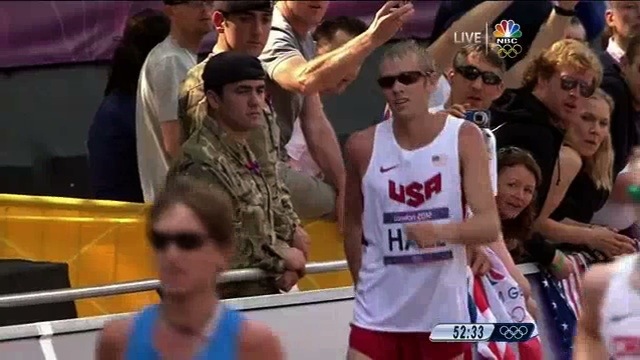
Unfortunate and sad news again in the running community as Ryan Hall has announced he is dropping out of the New York City Marathon due to “several nagging injuries.” I had blogged about his injuries before as his chance at the gold medal in London fell short at mile ten as he stopped due to hamstring tightness interfering with his gait. It just frustrates me to hear that he is still being plagued by plantar fasciitis. He admitted the problem began last november (http://news.runnersworld.com/2012/03/07/ryan-hall-has-plantar-fasciitis/) upon which he took 3 weeks off and had an MRI done to rule out any underlying stress fractures. At this time his treatment was being rendered by chiropractor John Ball of Phoenix an had consisted of shockwave therapy, as well as the traditional night splint, stretching, massage, golf ball and strengthening. He also admitted that he needed to spend more time doing strengthening exercises with his feet.
Plantar fasciitis is an epidemic in our society that should without a doubt not exist to the extent that it does. It is an overuse phenomenon that is secondary to weak musculature that can be prevented. Dr. Irene Davis, PhD, PT, FAPTA, director of the Spaulding National Running Center of Harvard Medical School, admits that she came to the realization that flip flops were not the culprit of plantar fasciitis because of lack of support. It was happening to feet that were weak from being in traditional supportive shoe great for most of the year and when the weather improved the rapid change to a non supportive shoe was too much stress to the weak foot. It is not the flip flop itself. I see this numerous times daily in my practice. Many of my patients careers force them to wear stiff soled shoes which puts them at great risk for plantar fasciitis by inhibiting motion and thus inducing weakness to the foot muscles. This ultimately leads to an overuse injury sometimes as a result of the normal activities that we perform daily.
Another interesting fact is that roughly forty years ago the medical field had considered this same condition to be caused by “heel spurs” on the calcaneous or heel bone. Years later it was established that the spur was not the true cause of pain and that many people who had existing heel spurs did not suffer from heel pain. It was then renamed as plantar fasciitis and described as a inflammation of the plantar fascia at its insertion site on the heel bone. Ironically, when microscopic studies have been performed on cases of chronic plantar fasciitis, there were no inflammatory cells noted within the tissue. Several studies have repeated these findings. 1,2.
Anatomically speaking, immediately next to the plantar fascia is a muscle known as the abductor hallucis. It just so happens that this muscle is the main supporter of the arch. 3,4,5 When muscles and tendons become inflamed, they tend to become painful when upon arising in the morning after not being used at night. This is a classic finding in any tendinitis. Plantar fasciitis is routinely known for being painful in the AM when first getting out of bed. Is an over used and weak abductor hallucis muscle the culprit for heel pain? Should this chronic condition be renamed abductor hallucis tendinitis?
So lets not blame Halls’ heel pain on weak foot musculature, after all he should have strong feet given all the miles he puts on them. But, could these miles he’s logging traditional trainers be putting him at risk?
1. Lemont H, Ammirati KM, Usen N. Plantar fasciitis: a degenerative process (fasciosis) without inflammation. J Am Podiatr Med Assoc. 2003 May-Jun;93(3):234-7.
2. Wearing SC, Smeathers JE, Urry SR, Hennig EM, Hills AP. The pathomechanics of plantar fasciitis. Sports Med. 2006;36(7):585-611
3. Fiolkowski P, Brunt D, Bishop M, Woo R, Horodyski M. Intrinsic pedal musculature support of the medial longitudinal arch: an electromyography study. J Foot Ankle Surg. 2003 Nov-Dec;42(6):327-33.
4. Jung DY, Kim MH, Koh EK, Kwon OY, Cynn HS, Lee WH. A comparison in the muscle activity of the abductor hallucis and the medial longitudinal arch angle during toe curl and short foot exercises. Phys Ther Sport. 2011 Feb;12(1):30-5. Epub 2010 Sep 15.
5. Wong YS. Influence of the abductor hallucis muscle on the medial arch of the foot: a kinematic and anatomical cadaver study. Foot Ankle Int. 2007 May;28(5):617-20.




 Dr. Nick's Running Blog
